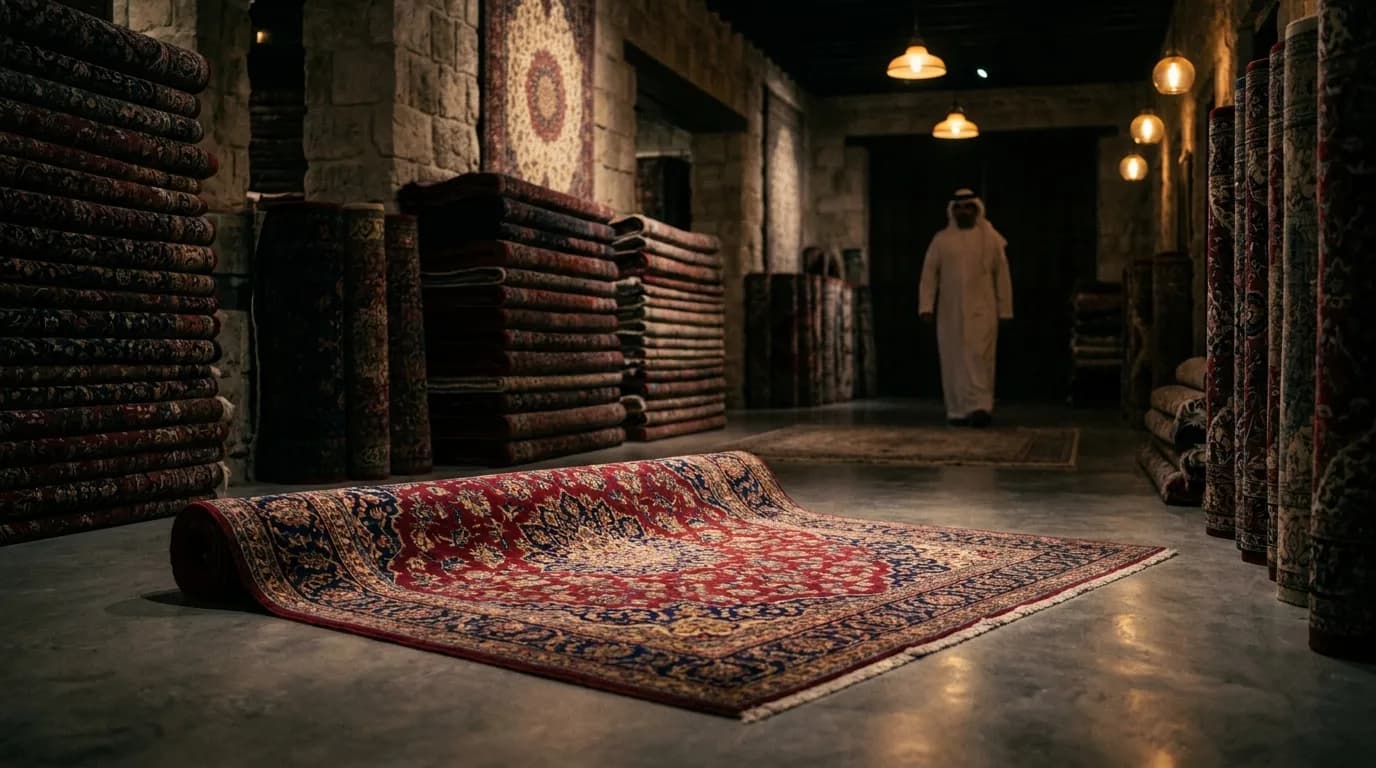
Quick Facts
Knot Density (Qum Silk): 300–1,000 knots per square inch — among the highest of any weaving tradition
Knot Density (Tabriz Wool): 60–200 knots per square inch, depending on quality grade
Price Range at Al Malakia: From AED 1,500 for small wool pieces to AED 150,000+ for fine Qum silk carpets
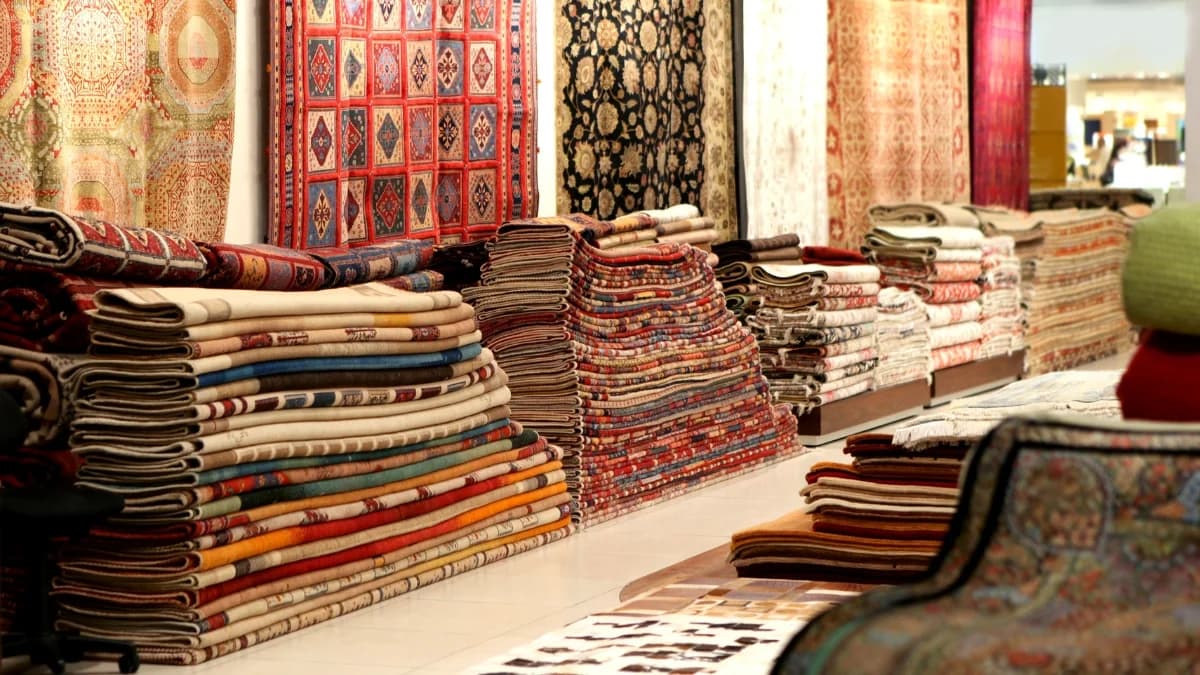
Stock on Display: 500+ hand-knotted Persian and Afghan carpets across four showroom units
Location: Shop 45–48, Central Souq Block 3 (Blue Souk), King Faisal Road, Sharjah, UAE
Drive Time from Dubai Marina: Approximately 30–40 minutes via Sheikh Zayed Road / E11
Founded: 2008, family-owned, sourcing directly from weavers in Iran
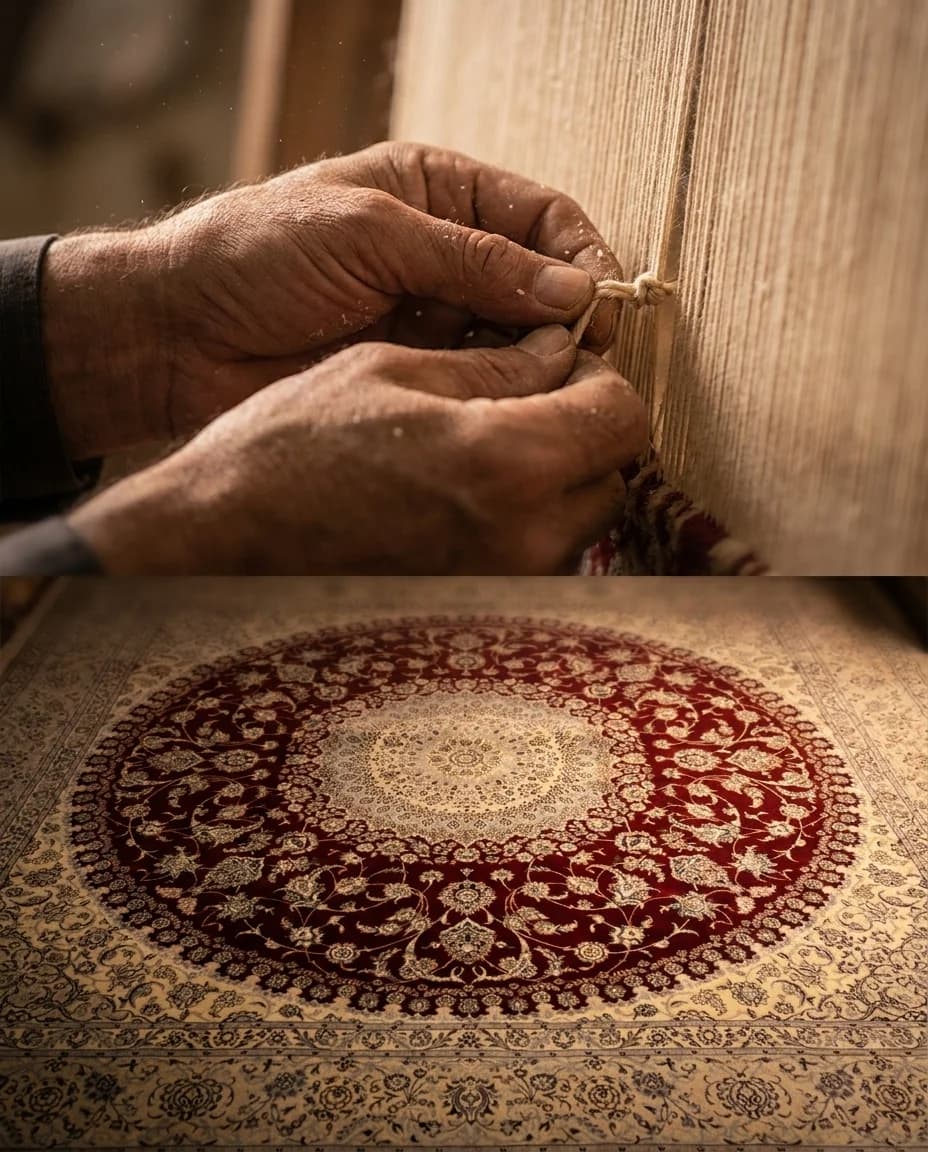
A hand-knotted Persian carpet contains between 25 and 1,000 knots per square inch, every one tied individually by hand — a fact that explains why a single carpet can take a skilled weaver between three months and three years to complete. In the UAE, where the market ranges from machine-made imitations to museum-grade silk masterpieces, knowing how to identify authentic pieces before you spend is essential. This guide covers the regional origins that determine a carpet's character, the technical indicators of quality, what to expect on price, and how to reach our Persian carpet showroom in Sharjah's historic Blue Souk.
Why Persian Carpets Are a Different Category Entirely
The term "Persian carpet" refers specifically to hand-knotted rugs originating in Iran, woven using the Persian (Senneh) or Turkish (Ghiordes) knotting technique. What separates them from machine-made or hand-tufted alternatives is structural integrity: each knot is individually secured to the warp threads, meaning the pile cannot delaminate, and the carpet, if properly cared for, will outlast its first owner by generations.
In 2010, UNESCO recognised traditional carpet weaving in Iran as Intangible Cultural Heritage, acknowledging not just the object but the entire ecosystem of knowledge — pattern vocabulary, natural dyeing methods, regional design schools — that produces it. When you buy a genuine Persian carpet, you are acquiring a document of that knowledge in physical form.
The Six Major Weaving Regions and What They Produce
Regional origin is the single most important variable in understanding a Persian carpet's character. Each city or district developed its own design grammar, pile material preferences, and knotting density over centuries. The following are the regions represented at Al Malakia:
| Region | Primary Material | Typical Knot Density | Design Character |
|---|---|---|---|
| Qum (Qom) | Pure silk | 300–1,000 KPSI | Medallion, pictorial, hunting scenes; extremely fine detail |
| Tabriz | Wool, silk, or wool-on-silk | 60–200 KPSI | Medallion-and-corner, Shah Abbasi floral; versatile scale |
| Isfahan | Wool on silk warp | 100–350 KPSI | Arabesque, palmette motifs; balanced, classical compositions |
| Kashan | Wool (Kork/Merino) | 100–400 KPSI | Central medallion, dense floral field; deep reds and navies |
| Nain | Wool with silk highlights | 200–700 KPSI | Ivory ground, delicate blue floral; light, contemporary palette |
| Afghan (Tribal) | Wool | 40–120 KPSI | Geometric gul motifs; earthy reds, rust, and charcoal |
KPSI = knots per square inch. Higher density generally correlates with finer detail and longer production time, but it is not the only quality indicator — wool grade, dye quality, and weaver skill matter equally.
How to Assess Quality Before You Buy
Buyers new to Persian carpets often focus on design alone. Experienced collectors check the following before making a decision:
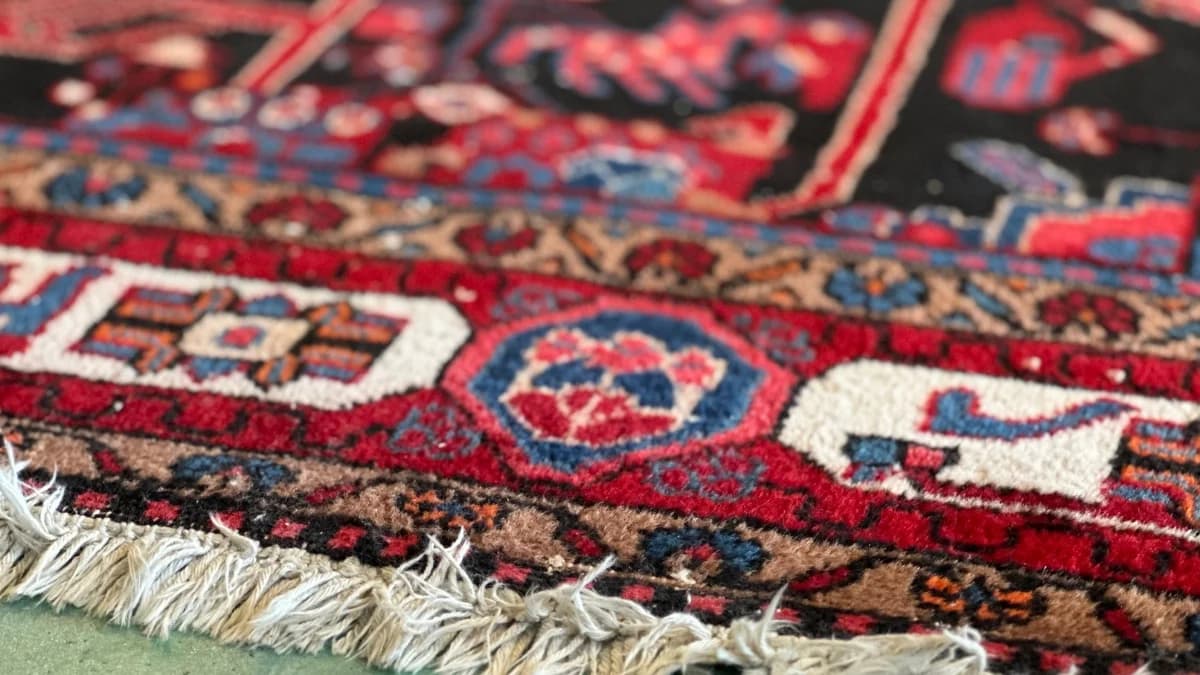
- Back of the carpet: On a hand-knotted piece, the pattern on the reverse should mirror the front almost perfectly. Blurred or indistinct reverse patterns indicate hand-tufted or machine-made construction.
- Knot count: Count knots along one inch of both warp and weft on the back, then multiply. A Qum silk at 400 KPSI and a Tabriz wool at 80 KPSI are both authentic — the number contextualises, not ranks, quality.
- Pile material: Rub the pile between your fingers. Silk has a cool, almost liquid feel and reflects light directionally (the colour shifts as you change viewing angle). High-quality kork wool feels soft and slightly waxy; coarse wool feels rough.
- Dye integrity: Dampen a white cloth and press it firmly on the pile. Authentic vegetable and chrome dyes will not transfer. Fugitive dyes indicate inferior materials or post-weave chemical washing.
- Fringe origin: On a genuine hand-knotted carpet, the fringe is an extension of the warp threads — it is part of the structure. Sewn-on fringe is a clear indicator of machine or tufted manufacture.
- Symmetry and tension: Lay the carpet flat. Genuine hand-knotted pieces may have minor irregularities — a slight curve in a border, a small variation in a repeat — that are evidence of hand production, not defects. Perfect machine regularity in every line suggests mechanical manufacture.
Understanding Price: What Drives the Cost of a Persian Carpet in the UAE
The UAE market includes pieces at every price point, and understanding the cost drivers prevents both overpaying and being misled by artificially low prices. The primary variables are:
- Material: Silk is approximately four to six times more labour-intensive to weave than wool at equivalent density, and the raw fibre costs significantly more. A Qum silk will always command a premium over a wool piece of similar dimensions.
- Knot density and size: A 3×2 metre Nain at 400 KPSI contains roughly 2.5 million individual knots. The time cost alone places a floor on its price regardless of market conditions.
- Age and provenance: Antique pieces (80+ years) with documented provenance carry a collector premium. New carpets woven in traditional workshops are not inferior — many contemporary Kashan and Qum weavers produce work equal to historical pieces — but they are priced differently.
- Source proximity: Dealers who source directly from weaving workshops in Iran, as Al Malakia does, can offer better value than those who purchase through multiple wholesale intermediaries, because margin layers are reduced.
As a broad reference: small wool pieces (approximately 1×1.5 m) in good quality begin around AED 1,500–3,000. A mid-size Tabriz or Kashan (2×3 m) in fine wool typically ranges from AED 8,000 to AED 35,000 depending on density and age. Fine Qum silk pieces of similar dimensions begin at AED 25,000 and can reach AED 150,000 or more for museum-grade work.
What to Watch Out For in the UAE Carpet Market
The UAE's carpet market is large and diverse, and not every seller operates with full transparency. Common issues include:
- Mislabelling of origin: Carpets described as "Persian design" or "Persian style" are not Persian carpets. Iranian origin should be verifiable through the weaver's signature (often woven into a corner cartouche) or a certificate of authenticity.
- Chemical washing to simulate age: A common practice involves treating new carpets with caustic chemical baths to artificially soften and antique the appearance. The result looks mellow but the pile is weakened and lifespan is reduced significantly.
- Machine-made pieces at hand-knotted prices: In a retail environment, always turn the carpet over. The back does not lie.
- Pressure selling: Authentic carpet dealers welcome examination time. If a seller discourages you from inspecting the back or rushes you toward a decision, treat that as a signal.
Caring for a Persian Carpet in a UAE Home
The Gulf climate presents specific challenges: low humidity in air-conditioned interiors can dry out wool fibres over time, while direct sunlight through glass fades natural dyes. The following practices extend carpet lifespan substantially:
- Rotate the carpet 180° every six to twelve months to distribute foot traffic and light exposure evenly.
- Use a quality underlay — it protects the foundation, prevents slipping, and extends cleaning intervals.
- Vacuum along the pile direction only, never against it, and avoid motorised brush attachments on silk pieces.
- Professional hand-washing every three to five years, depending on foot traffic. Do not use household carpet cleaning machines on hand-knotted pieces.
- For spills, blot immediately with a clean, dry cloth. Do not rub. Water-soluble spills on wool can typically be addressed with cold water; oil-based spills require professional attention.
Getting to Al Malakia: From Dubai and Abu Dhabi
Al Malakia is located at Shop 45–48, Central Souq Block 3 — known widely as the Blue Souk — on King Faisal Road, Sharjah. The Blue Souk is one of the UAE's most recognisable commercial landmarks and is straightforward to reach from both emirates.
From Dubai: The showroom is approximately 30–40 minutes by car from Dubai Marina and 20–25 minutes from Deira, depending on traffic. Al Malakia offers a complimentary door-to-door transfer service from Dubai hotels — contact us via WhatsApp on +971 50 537 2997 to arrange. Full details on the Dubai transfer page.
From Abu Dhabi: The drive is approximately 90 minutes via Sheikh Zayed Road (E11). Private transfer arrangements are available — see the Abu Dhabi visitor page for details.
Opening hours: Saturday–Thursday 10:00–22:00; Friday 14:00–22:00.
Why Visit Al Malakia Persian Carpets
Al Malakia was founded in 2008 by a family with decades of direct relationships with weaving workshops across Iran. The showroom in Sharjah's Blue Souk holds more than 500 hand-knotted carpets on display at any one time — spanning Qum silk, Tabriz wool and wool-on-silk, Isfahan, Kashan, Nain, and Afghan tribal pieces. Every carpet is sourced directly from weavers, removing intermediary layers and providing better value at each price point.
There is no sales pressure. You are welcome to examine any piece, ask for the back to be shown, and take your time. Staff can explain the weaving technique, regional origin, and age of every item in stock.
Visit us: Shop 45–48, Central Souq Block 3 (Blue Souk), King Faisal Road, Sharjah | Call: +971 6 573 1399 | WhatsApp: +971 50 537 2997 | Contact page
Frequently Asked Questions
How do I know if a Persian carpet is genuinely hand-knotted?
Turn the carpet over and examine the back. On a hand-knotted piece, the pattern on the reverse will be clear and detailed, almost as sharp as the front, because the knots are tied individually through the warp and weft. Machine-made carpets have a uniform looped or glued backing with no visible knot structure. Hand-tufted carpets have a canvas backing glued on to hide the tufting gun holes — you may feel a stiffness or see the backing material. The fringe is also telling: on genuine hand-knotted carpets, fringe is the extension of the warp threads; on imitations, it is sewn or glued on separately.
What is the difference between a Qum silk carpet and a Tabriz wool carpet?
The differences are material, density, and typical use. Qum (or Qom) silk carpets are woven entirely from silk pile on a silk foundation. They achieve the highest knot densities of any Persian weaving tradition — up to 1,000 knots per square inch — and are prized for their ability to render fine pictorial detail and their characteristic light-reflective shimmer. They are generally considered collector's pieces and are often displayed on walls or in low-traffic areas. Tabriz carpets use wool pile (sometimes with silk highlights) on a cotton or silk foundation. They are highly durable, available in a wide range of densities and sizes, and are practical for floor use in living and dining rooms. Both are authentic hand-knotted Persian carpets; they simply serve different purposes and carry different price levels.
Are Persian carpets a good investment?
Fine hand-knotted Persian carpets have historically held or increased in value over long time periods, particularly pieces in good condition from established weaving cities such as Qum, Isfahan, and Kashan. However, the carpet market is not a regulated investment market, and value is determined by condition, authenticity, regional origin, age, and collector demand — all of which require expertise to assess accurately. Buying from a direct-source dealer with transparent provenance information reduces the risk of acquiring misrepresented pieces. The most reliable approach is to buy a carpet you would want to own regardless of resale value, with the understanding that quality pieces are unlikely to depreciate in real terms if properly maintained.
Can I bring a Persian carpet purchased in Sharjah back to my home country?
In most cases, yes. Hand-knotted Persian carpets purchased in the UAE are not subject to UAE export restrictions. Import regulations vary by destination country — most GCC, European, and North American countries permit the import of personal-use carpets, though commercial quantities may require documentation. Some countries apply import duty based on declared value. We recommend checking your country's customs authority website before travel. Al Malakia can provide a detailed receipt describing the carpet's origin, materials, and value, which satisfies most customs documentation requirements.
How long does it take to weave a Persian carpet?
Production time depends almost entirely on size and knot density. A small prayer-size Kashan (approximately 0.6×1 m) at 200 KPSI might take one weaver three to four months working full days. A large Qum silk piece (3×2 m) at 500 KPSI — containing approximately five million knots — can take a team of two or three weavers two to three years. This production time is the primary reason that fine Persian carpets command the prices they do: there is no shortcut to hand-knotting five million individual knots to a precise pattern.
Does Al Malakia offer a transfer service from Dubai hotels?
Yes. Al Malakia provides a complimentary door-to-door transfer service from hotels in Dubai to the showroom in Sharjah's Blue Souk and back. The service is available by prior arrangement — contact us via WhatsApp on +971 50 537 2997 at least a day in advance to confirm timing. For visitors travelling from Abu Dhabi, private transfer arrangements can also be made. Full details are on our Dubai and Abu Dhabi visitor pages.
Plan Your Visit
If you are considering a Persian carpet purchase in the UAE, the most useful single step is to see hand-knotted pieces in person. Photographs do not convey the tactile difference between wool grades, the directional shimmer of silk, or the scale of a large-format carpet in a room-like setting. Al Malakia's showroom at the Blue Souk in Sharjah holds over 500 pieces across all major weaving regions, with no minimum spend and no obligation to purchase. Browse our full carpet collection before your visit, or reach us directly on WhatsApp at +971 50 537 2997 to ask about specific origins, sizes, or price ranges before you make the trip.