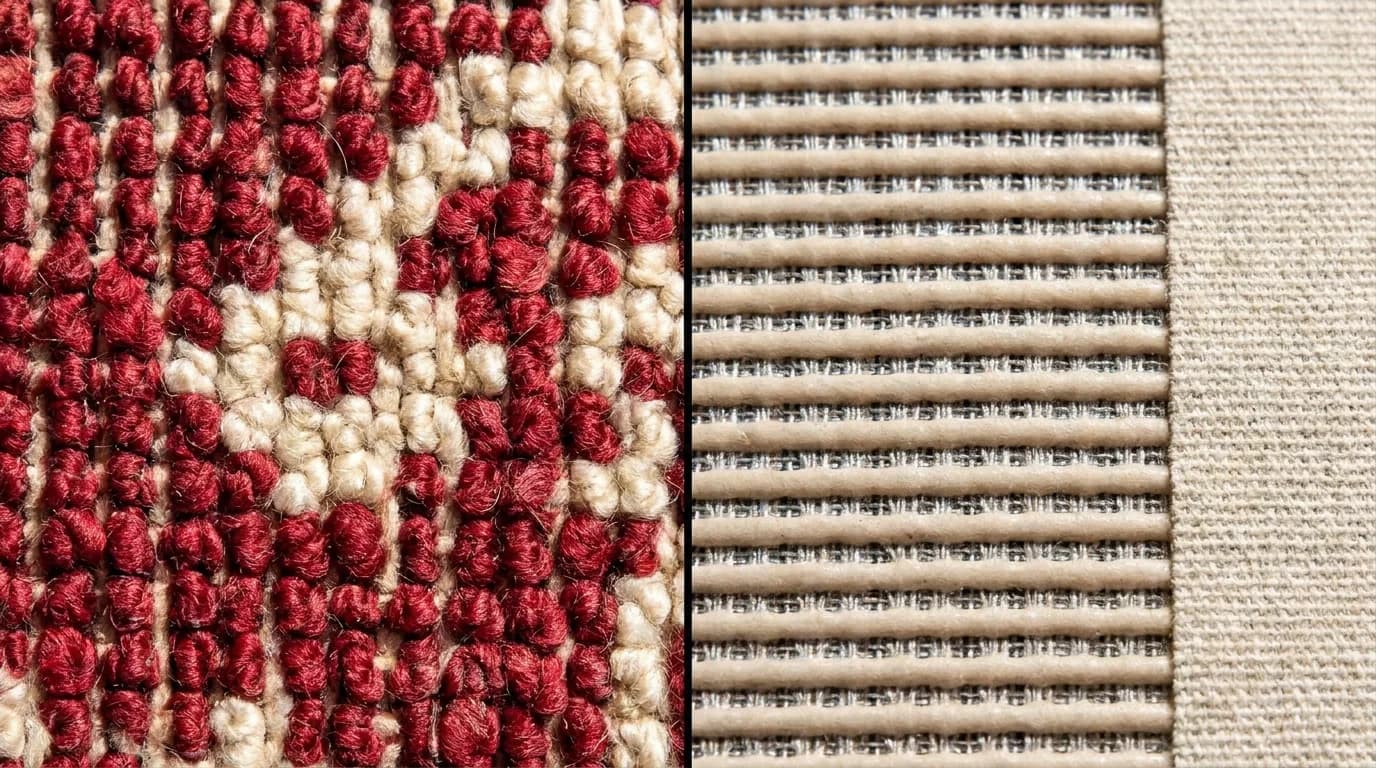
Knot density (hand-knotted): 100–800+ knots per square inch, depending on origin and material
Knot density (machine-made): Simulated knot appearance; no true individually tied knots
Lifespan: Hand-knotted Persian carpets regularly last 50–150+ years; machine-made rugs typically 5–15 years
Price range at Al Malakia: AED 1,500–AED 150,000+ depending on size, origin, and material
Stock available: 500+ hand-knotted Persian and Afghan carpets at the Blue Souk, Sharjah
Showroom address: Shop 45–48, Central Souq Block 3, King Faisal Road, Sharjah, UAE
A genuine hand-knotted Persian carpet from Qum can contain up to 800 individual knots per square inch — each one tied by hand, one at a time, by a weaver who may spend two years completing a single piece. A machine-made rug replicates the visual pattern of that carpet in a matter of hours. Knowing which is which, and why it matters, is the single most important skill any carpet buyer can develop. This guide, written from over 15 years of direct trade experience at Al Malakia Persian Carpets, gives you the facts.
What "Hand-Knotted" Actually Means
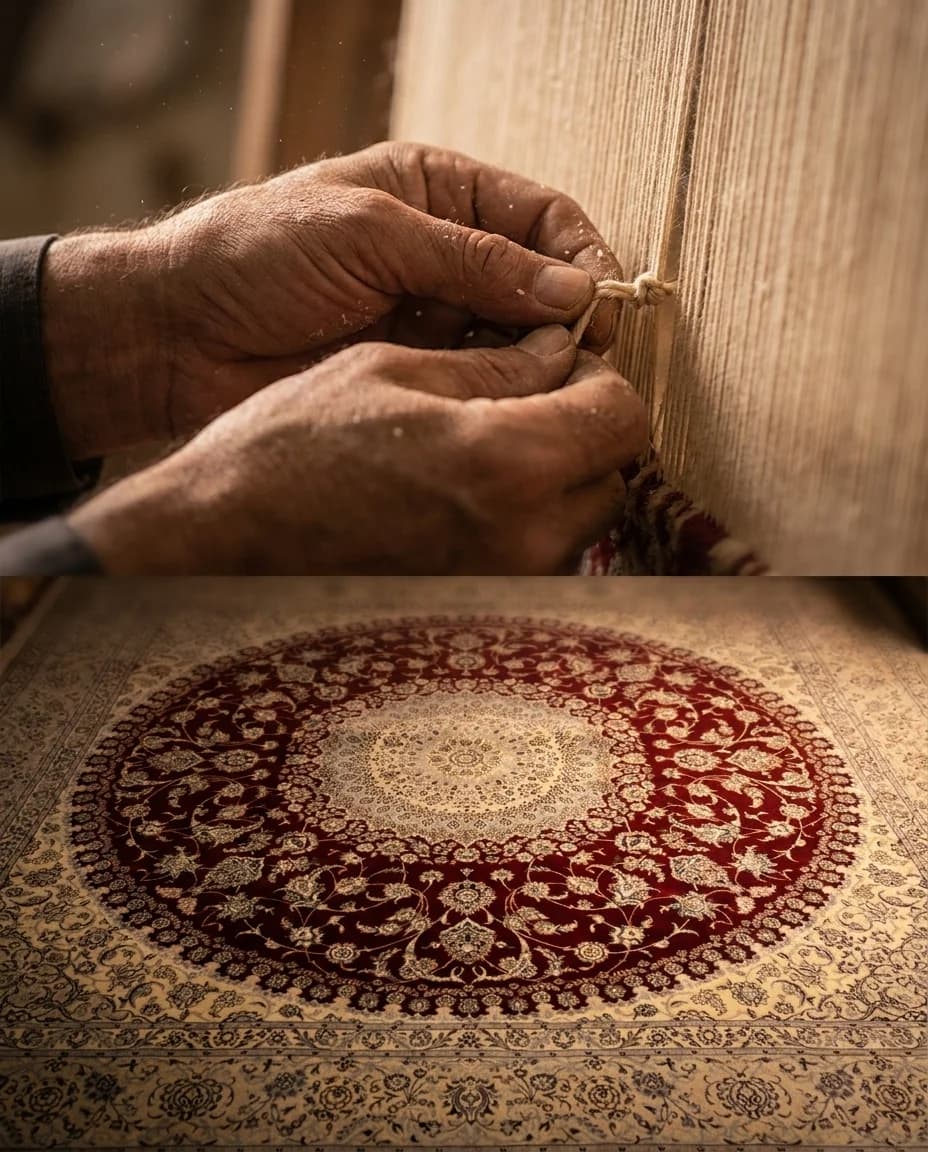
The term "hand-knotted" refers to a specific construction method in which individual strands of yarn — wool, silk, or cotton — are tied one by one around the vertical threads (the warp) of a loom. Each knot is then cut, and the process repeats, row by row, until the pile surface of the carpet is formed. The two dominant knot types are the Persian (Senneh) knot and the Turkish (Ghiordes) knot, both of which are well documented in carpet scholarship.
In cities like Kashan, Isfahan, and Nain, weavers work on vertical looms and can tie between 8,000 and 14,000 knots per day. A 2 × 3 metre carpet of moderate density (200 knots per square inch) contains roughly 1.3 million individual knots. That figure alone explains why production time runs from several months to several years.
What "Machine-Made" Actually Means
Machine-made rugs are produced on power looms — computerised machinery that inserts pre-dyed yarn into a backing material at high speed. The process is precise and consistent, but it does not create independent, individually tied knots. Instead, yarns are looped and locked into a synthetic or woven backing using a tufting or Wilton weave process.
The visual result can closely resemble a hand-knotted carpet to an untrained eye. However, the structural integrity, the material quality, and the long-term behaviour of the two products are fundamentally different.
How to Tell the Difference: Five Practical Tests
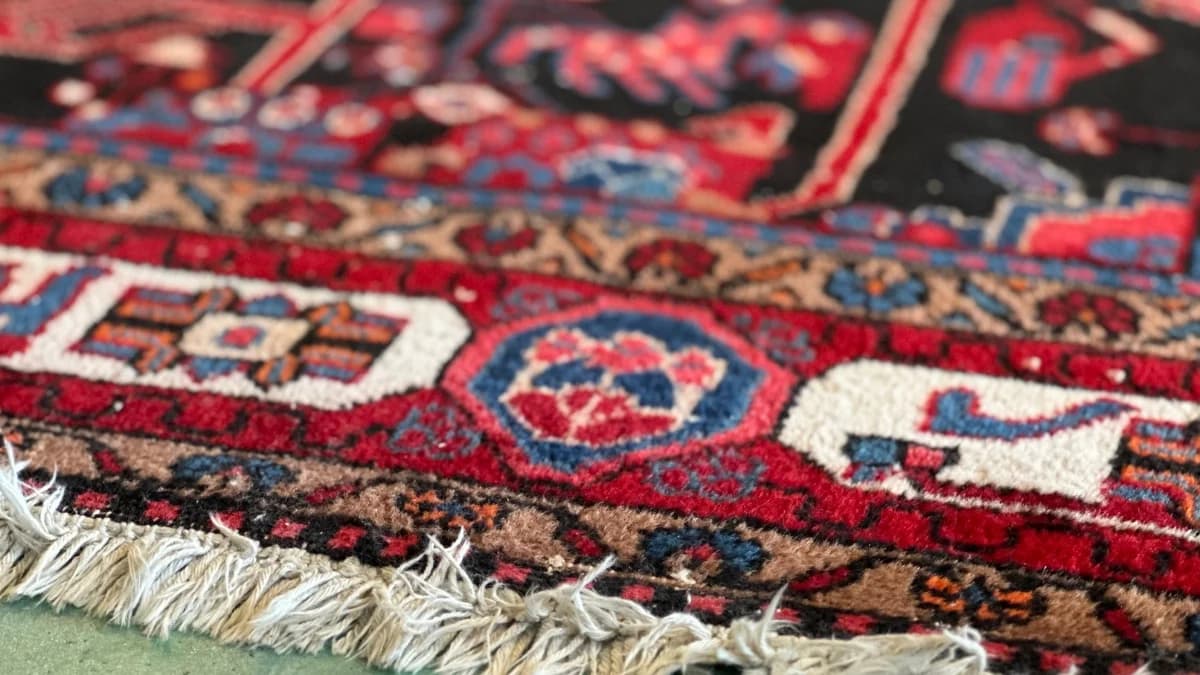
- Turn it over. On a genuine hand-knotted carpet, the back reproduces the pattern with the same clarity as the front. On a machine-made rug, the back shows a uniform, often synthetic backing with no visible knot structure.
- Look for irregularity. Hand-knotted carpets display subtle variations in line sharpness, pile height, and colour — not flaws, but evidence of human craftsmanship. Machine-made rugs are perfectly uniform.
- Check the fringe. On a hand-knotted carpet, the fringe is an extension of the warp threads — it is structural. On a machine-made rug, fringe is typically sewn or glued onto the ends.
- Bend the pile. Hand-knotted wool and silk pile springs back slowly and unevenly. Synthetic machine-made pile often bounces back immediately and uniformly.
- Ask for the origin certificate. Reputable hand-knotted carpets from Iran are accompanied by documentation. At Al Malakia, every piece is sourced directly from weavers and regional workshops.
Side-by-Side Comparison
| Factor | Hand-Knotted | Machine-Made |
|---|---|---|
| Construction | Individual knots tied by hand | Power-loomed, tufted or Wilton weave |
| Knot density | 100–800+ KPSI | No true knots |
| Materials | Wool, silk, cotton — natural fibres | Often polypropylene, nylon, or blended synthetics |
| Lifespan | 50–150+ years | 5–15 years |
| Repairability | Can be rewoven, re-piled, restored | Difficult or impossible to repair authentically |
| Resale value | Appreciates or holds value over decades | Depreciates rapidly |
| Price range | AED 1,500–150,000+ | AED 100–3,000 |
| Provenance | Traceable to region, city, workshop | Factory-produced, no regional identity |
Why Knot Density Matters So Much
Knot density — measured in knots per square inch (KPSI) — is one of the most reliable indicators of quality in hand-knotted carpets. Higher density means finer detail in the pattern, greater durability, and usually a higher material cost. Here is a practical reference:
- Under 100 KPSI: Tribal and village carpets (Persian Gabbeh, Afghan Kilim-pile); bold patterns, lower price point.
- 100–200 KPSI: City carpets (Tabriz, Kashan wool); detailed floral and medallion designs.
- 200–400 KPSI: Fine city carpets (Isfahan, Nain 9-La); curvilinear patterns with high fidelity.
- 400–800 KPSI: Silk and wool-on-silk carpets (Qum, Tabriz 30-Raj); miniature-level detail, collector pieces.
For a deeper look at how origin affects quality and price, see The Complete Guide to Buying Persian Carpets in the UAE.
The Question of Long-Term Value
A machine-made rug purchased for AED 800 today will likely need replacing within a decade. A hand-knotted Kashan carpet purchased for AED 8,000 today may be worth more in 20 years — and will almost certainly still be in usable, attractive condition. This is not speculative: auction records for antique Persian carpets consistently demonstrate that well-maintained, high-quality pieces retain and build monetary value over time.
Beyond resale, the practical economics differ too. Hand-knotted carpets can be professionally cleaned, repaired, and re-fringed. Their natural fibre pile — wool or silk — is inherently resilient and does not shed microplastics. For families with children or high foot-traffic areas, the durability argument for hand-knotted is substantial.
When Machine-Made Makes Sense
It would be intellectually dishonest to dismiss machine-made rugs entirely. There are situations where they are a reasonable choice:
- Temporary accommodation or rental properties where longevity is not a priority
- High-moisture areas (bathrooms, utility rooms) where a natural fibre investment is impractical
- Very tight budgets where a floor covering is needed immediately
- Children's play areas where the rug is expected to be replaced within a few years
What machine-made rugs cannot offer is craftsmanship, provenance, repairability, or long-term value. If those factors matter to you — and for most living rooms, dining rooms, and reception areas, they should — a hand-knotted carpet is the rational choice.
Origins Matter: Where a Carpet Comes From Shapes What It Is
Hand-knotted is not a single category. A Qum silk carpet and a Tabriz wool carpet are both hand-knotted, but they differ significantly in technique, material, pattern tradition, and price. At Al Malakia, our Persian carpet collection spans the major weaving cities of Iran:
- Qum (Qom): Finest silk carpets; 400–800 KPSI; floral, hunting, pictorial scenes
- Tabriz: Wool, silk, and wool-on-silk; 150–500 KPSI; medallion and pictorial formats
- Isfahan: Fine wool on cotton or silk warp; 200–400 KPSI; arabesque floral patterns
- Kashan: Durable wool pile; 160–300 KPSI; classic medallion designs popular in the UAE
- Nain: Extremely fine wool with silk highlights; 300–600 KPSI; pale, intricate patterns
Understanding these distinctions is covered in detail in our complete Persian carpet buying guide — recommended reading before any significant purchase.
Visit Al Malakia Persian Carpets in Sharjah
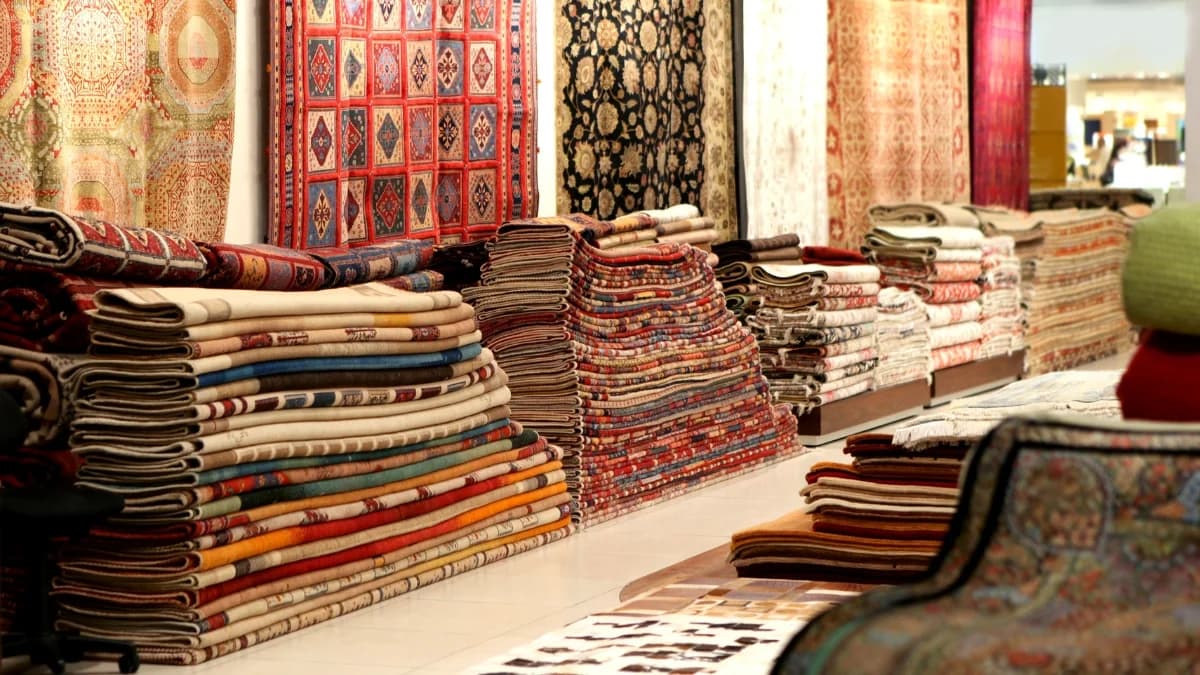
Al Malakia Persian Carpets has been family-owned and operated since 2008, sourcing directly from weavers across Iran. Our showroom at Shop 45–48, Central Souq Block 3 (Blue Souk), King Faisal Road, Sharjah holds 500+ hand-knotted Persian and Afghan carpets across all price points.
We offer free door-to-door transfer from Dubai hotels and can arrange private transfers from Abu Dhabi. There is no obligation to purchase — we welcome visitors who are still learning.
Opening hours: Saturday–Thursday 10:00–22:00 | Friday 14:00–22:00
Call or WhatsApp: +971 50 537 2997 | Contact us
Visitors from Dubai can find directions and transfer details at our Dubai visitor page. Visitors from Abu Dhabi can find information at our Abu Dhabi visitor page.
Frequently Asked Questions
How can I tell if a carpet is truly hand-knotted and not hand-tufted?
Hand-tufted carpets occupy a middle ground: they are made by hand using a tufting gun that punches yarn through a canvas backing, which is then covered with a cloth glued to the base. To distinguish hand-tufted from hand-knotted, turn the carpet over. A hand-knotted carpet shows the actual pattern on the reverse with visible knot rows. A hand-tufted carpet has a felt or fabric backing glued on — you cannot see the pile construction. Hand-tufted carpets are not the same as hand-knotted and do not carry the same value or longevity.
Do hand-knotted carpets increase in value over time?
Well-maintained hand-knotted Persian carpets from established weaving cities — particularly silk Qum, fine Isfahan, and Nain — have a strong historical track record of holding and increasing in value. This is especially true for pieces with high knot density, natural dyes, and documented provenance. Value appreciation is not guaranteed for every piece, but it is a realistic expectation for quality carpets kept in good condition, professionally cleaned, and stored correctly when not in use.
What is the difference between Persian and Afghan hand-knotted carpets?
Persian carpets originate from Iran and encompass a wide range of city and village traditions — Kashan, Isfahan, Tabriz, Qum, Nain, among others. They are known for intricate floral, medallion, and pictorial designs. Afghan hand-knotted carpets — including the Afghan Chobi and Ziegler styles — are typically woven with a heavier wool pile, more geometric patterns, and natural or vegetable-dyed yarns. They are robust, highly durable, and carry a distinct aesthetic. Both categories are genuinely hand-knotted; they differ in tradition, pattern language, and handle. Al Malakia carries both.
Is a higher knot count always better?
Not always — it depends on what you need. A tribal carpet with 80 KPSI is not inferior to a Nain with 400 KPSI; they are made for different purposes and express different aesthetics. However, within a single weaving tradition and design type, higher knot density generally means finer detail resolution, greater durability in the long term, and a higher material and labour cost. For decorative, collector-quality pieces, knot density is a key quality indicator. For a large area rug used primarily for floor coverage, mid-density wool carpets represent excellent practical value.
How do I care for a hand-knotted Persian carpet in the UAE climate?
The UAE's dry climate is generally favourable for natural fibre carpets — extreme humidity is the greater enemy, and Sharjah and Dubai interiors are well air-conditioned. Rotate the carpet every 12–18 months to even out foot traffic and light exposure. Vacuum regularly on a low setting, always in the direction of the pile. For deep cleaning, use a specialist hand-knotted carpet cleaner — avoid steam cleaning, which can loosen knots and distort the foundation. Keep the carpet away from direct prolonged sunlight to prevent colour fading, particularly for silk pieces.
Can I visit Al Malakia from Dubai without a car?
Yes. Al Malakia offers a free door-to-door transfer service from Dubai hotels — contact us on WhatsApp at +971 50 537 2997 to arrange a pick-up time. The Blue Souk in Sharjah is also reachable by taxi from Dubai in approximately 30–45 minutes depending on traffic. More details are available on our Dubai visitor page.
The difference between hand-knotted and machine-made is not simply a matter of price — it is a difference in what the object fundamentally is. A hand-knotted Persian carpet is the product of months or years of skilled labour, regional tradition, and natural materials selected for durability over generations. If you are ready to see that difference in person, visit us at the Blue Souk in Sharjah, or send a WhatsApp message to arrange your visit. Our team, including second-generation merchant Eid Al Salam, is available Saturday through Thursday from 10:00 to 22:00, and Friday from 14:00.