Minimum knot density (authentic Persian): 100 KPSI (knots per square inch) for quality wool; 300–800 KPSI for fine Qum silk
Price indicator: A genuine hand-knotted Persian carpet starts at approximately AED 2,000–3,000 for a small wool piece; Qum silk pieces regularly exceed AED 30,000
Weaving origins covered at Al Malakia: Qum, Tabriz, Isfahan, Kashan, Nain — sourced directly from Iranian weavers since 2008
Quick burn test result: Wool and silk smell of burning hair and self-extinguish; synthetic fibres melt and smell of plastic
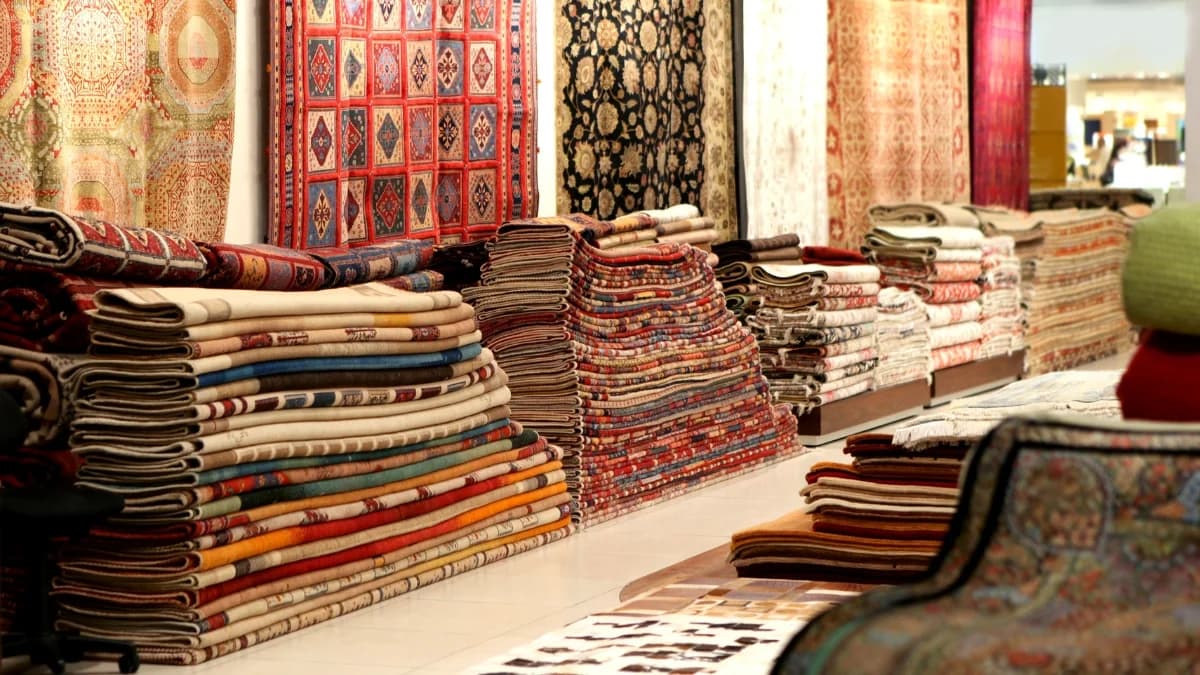
Showroom stock: 500+ hand-knotted Persian and Afghan carpets at Shop 45–48, Blue Souk, Sharjah
Free transfer service: Door-to-door from Dubai hotels; private transfers arranged from Abu Dhabi
Over a million square metres of machine-made rugs are sold each year under the label "Persian carpet." The UNESCO-listed craft of Persian carpet weaving takes months or years per piece; a machine replicates the visual pattern in hours. The price difference can be enormous, and so can the disappointment when a buyer realises what they actually purchased. This guide gives you seven concrete, hands-on checks you can carry out in any showroom before you commit to a purchase.
1. Turn the Carpet Over and Count the Knots
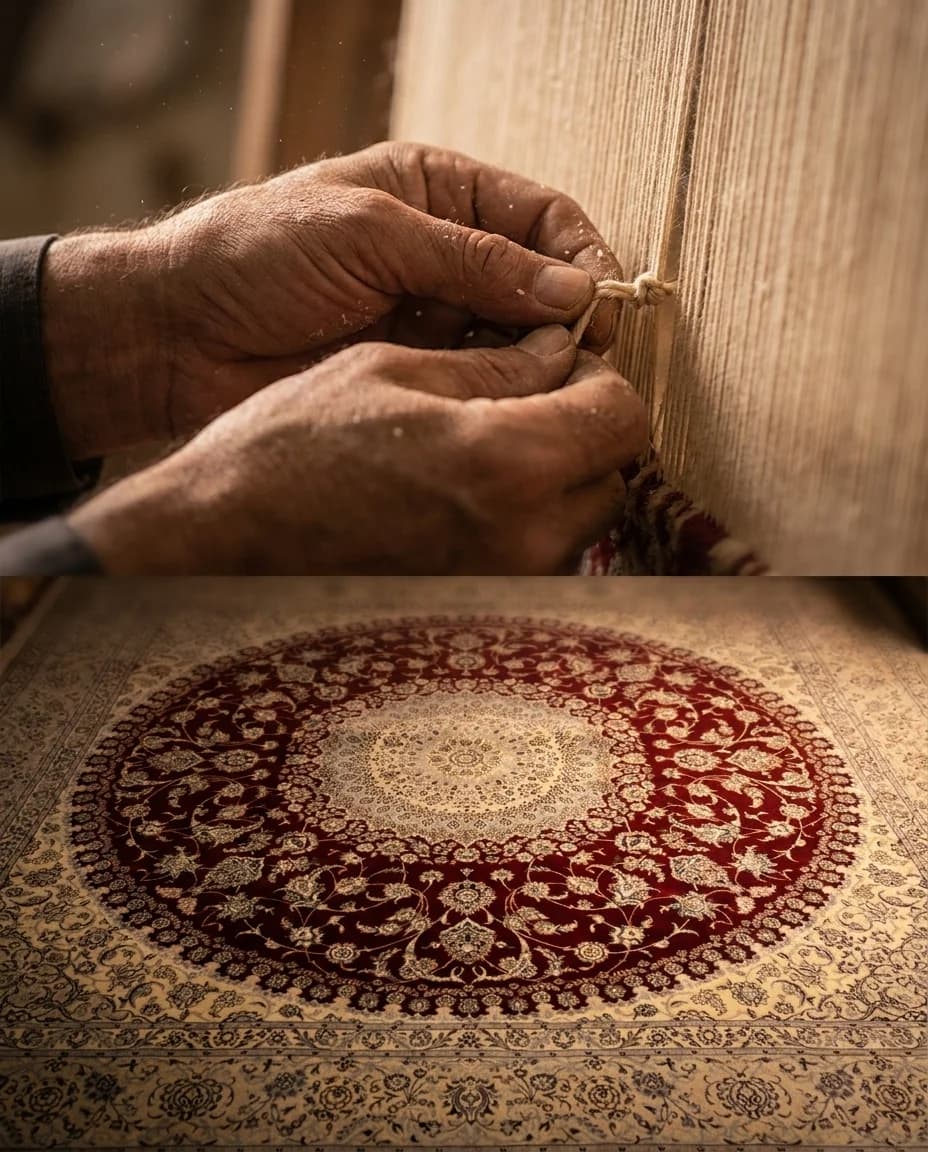
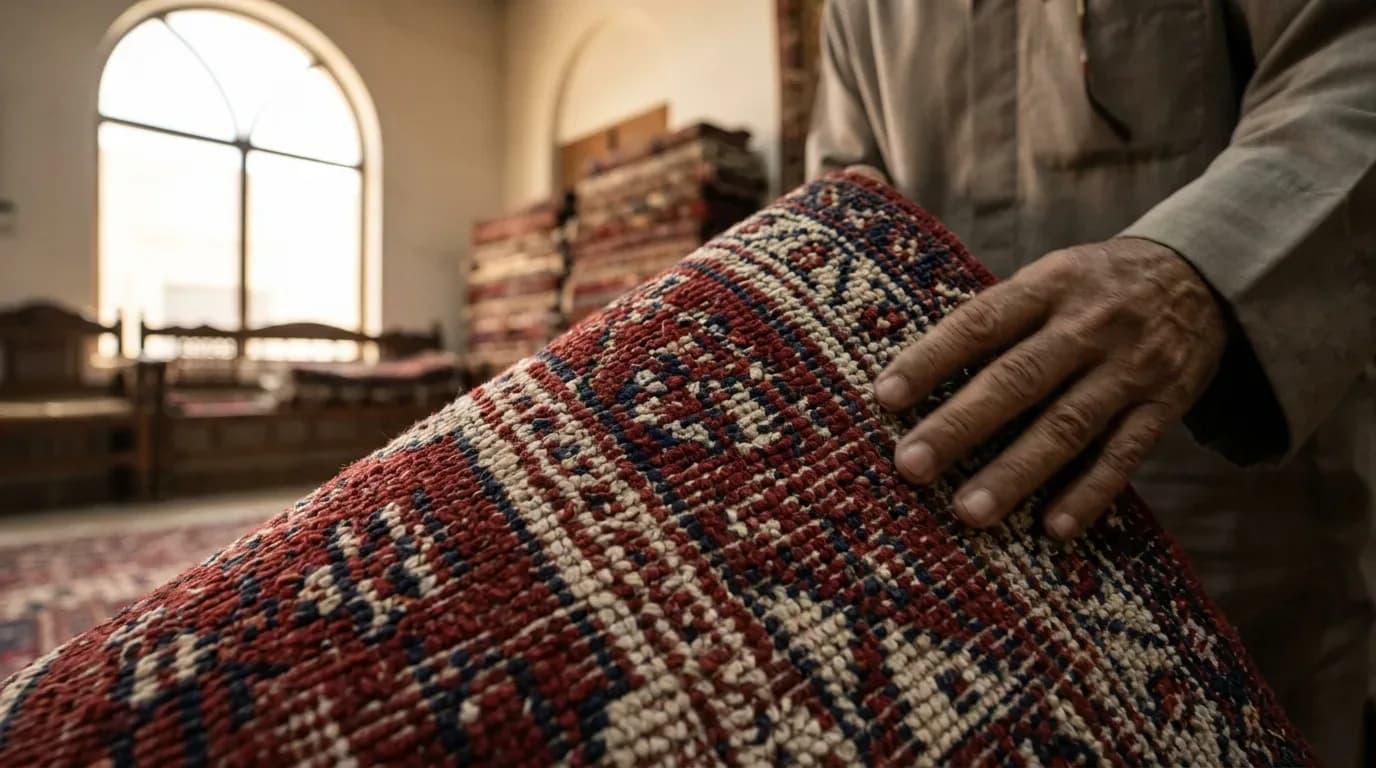
The single most reliable indicator of authenticity is the knot count on the reverse of the carpet. On a genuine hand-knotted Persian carpet, you will see individual knots — each tied by hand around the warp threads. Count the knots along one inch horizontally and one inch vertically, then multiply the two numbers. This gives you the KPSI (knots per square inch).
- Entry-level Persian wool (e.g. Tabriz 40-raj): 100–160 KPSI
- Mid-grade Persian wool (e.g. Tabriz 60-raj, Kashan): 160–300 KPSI
- Fine Qum silk or Nain: 300–800+ KPSI
- Machine-made "Persian-style": The back shows uniform, mechanical loops — no individual knots visible
A machine-made carpet back looks woven rather than knotted. The lines are perfectly even because they were produced by a computer-controlled loom, not a weaver's hands.
2. Examine the Fringe — It Must Be Part of the Carpet
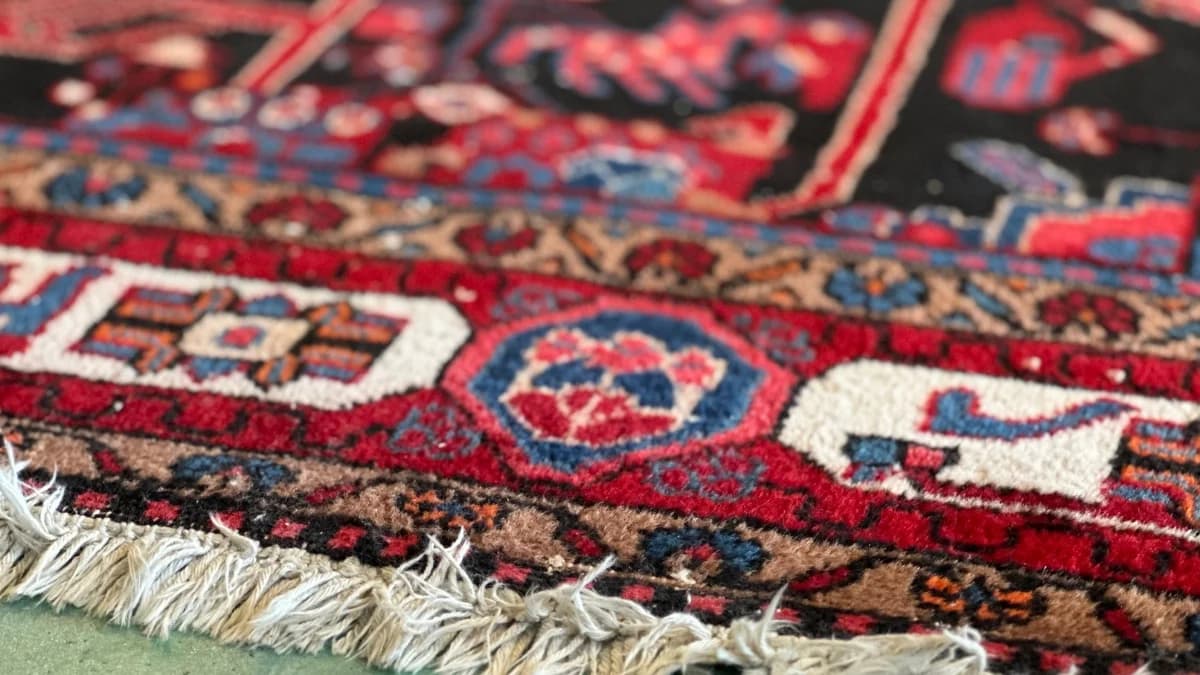
On an authentic hand-knotted carpet, the fringe is an extension of the structural warp threads. It grows naturally from the body of the carpet. On a fake, the fringe is typically glued or sewn on as a decorative afterthought.
Gently pull a few fringe threads and observe: if the thread continues into the carpet pile, it is structural and genuine. If it detaches easily or shows a line of stitching at the base where it meets the carpet body, it has been added artificially.
3. Run the Burn Test on a Loose Fibre
Ask the seller for permission to take a small loose pile fibre from the fringe or an inconspicuous edge. Hold it with tweezers over a flame:
| Fibre Type | Burn Behaviour | Smell | Residue |
|---|---|---|---|
| Wool | Burns slowly, self-extinguishes | Burning hair | Crushable ash |
| Silk | Burns slowly, self-extinguishes | Burning hair (subtler) | Fine, crushable ash |
| Viscose / Art Silk | Burns rapidly | Burning paper | Minimal ash |
| Polypropylene / Synthetic | Melts rather than burns | Plastic | Hard bead of melted material |
Viscose (artificial silk) is the most common substitute for genuine silk. It looks lustrous in the showroom but wears quickly and cannot hold the fine detail of real silk weaving.
4. Check for Colour Bleeding with a Damp Cloth
Natural dyes derived from plants and insects — pomegranate rind, indigo, madder root, walnut husks — are fixed into the wool or silk fibre through a mordanting process and do not bleed. Chemical dyes used in lower-quality or machine-made pieces often run when exposed to moisture.
Press a damp white cloth firmly against the carpet pile, hold for ten seconds, then lift. A small amount of surface dust is normal. A strong transfer of colour onto the cloth indicates chemical or low-quality dyes and is a warning sign.
5. Look at the Pattern Edges Under Close Inspection
In a hand-knotted carpet, design edges — the lines between a medallion and the field, for example — are slightly irregular when examined closely. This is not a flaw; it is the signature of a human hand. Each knot is tied individually, so curves are approximated row by row.
Machine-made carpets have perfectly sharp, digitally precise edges throughout the entire pattern. If every curve in a large carpet looks as crisp as a printed image, it was almost certainly produced by a machine.
6. Verify the Pile Height and Feel
Authentic Persian carpets from Kashan, Isfahan, and Nain typically have a shorter, firmer pile — often 5–8 mm — that reflects the high knot density. The pile feels dense and springy underfoot. Tabriz pieces vary more widely depending on the raj (knot count per 7 cm). Qum silk carpets have a very flat, almost rigid feel because the silk fibre is naturally taut.
Conversely, many machine-made or low-quality imitations use a thick, soft, loosely tufted pile to create an impression of luxury. A pile that looks impressively deep but feels almost spongy underfoot is a warning sign. Tufted carpets — where the pile is gun-punched into a backing and held with latex — will also show a canvas or latex backing when you fold the carpet.
7. Request Provenance Documentation
Reputable dealers who source directly from weavers can tell you the specific city or workshop of origin, the approximate date of weaving, the quality grade (raj count for Tabriz, for instance), and the fibre composition. At Al Malakia, every piece on the floor at Shop 45–48 in Sharjah's Blue Souk is sourced directly from Iran through established weaver relationships built over two generations, and that provenance can be discussed in detail for any carpet in the showroom.
If a seller cannot tell you the specific weaving city, the knot count, or the fibre type, treat that as a significant red flag. Authentic Persian carpets have a traceable origin. For a deeper understanding of carpet origins and weaving traditions, read our complete guide to Persian carpets in the UAE.
The Comparison at a Glance
| Feature | Authentic Hand-Knotted Persian | Machine-Made / Fake |
|---|---|---|
| Reverse side | Individual knots clearly visible | Uniform woven or looped backing |
| Fringe | Integral, part of warp threads | Sewn or glued on |
| Burn test | Burns like hair, self-extinguishes | Melts or burns like paper/plastic |
| Colour bleed | Minimal or none | Noticeable transfer to damp cloth |
| Pattern edges | Slightly irregular by hand | Digitally precise throughout |
| Pile feel | Dense, firm, springy | Often thick and spongy; latex backing |
| Provenance | Specific city, raj count, fibre type | Vague or absent |
Why Visit Al Malakia Persian Carpets?
Al Malakia was founded in 2008 by Eid Al Salam, a second-generation Persian carpet merchant with direct family relationships with weavers in Qum, Tabriz, Isfahan, Kashan, and Nain. The showroom at Shop 45–48, Central Souq Block 3 (Blue Souk), King Faisal Road, Sharjah holds more than 500 hand-knotted Persian and Afghan carpets at any one time — every piece with a traceable provenance.
We offer a free door-to-door transfer service from Dubai hotels and can arrange private transfers from Abu Dhabi. There is no pressure to purchase; come and compare, handle the carpets, and ask questions. Open Saturday–Thursday 10:00–22:00, Friday 14:00–22:00.
Browse our Persian carpet collection online, explore our Dubai transfer service, or contact us directly. WhatsApp: +971 50 537 2997.
Frequently Asked Questions
What is the easiest way to spot a fake Persian carpet at home?
Turn the carpet upside down and look at the back. On a genuine hand-knotted Persian carpet, individual knots are visible and the pattern on the reverse mirrors the front, though slightly less defined. A machine-made carpet will have a uniform, mechanical-looking back with no individual knots. You can also run a damp white cloth across the pile: significant colour transfer suggests low-quality chemical dyes, which are common in imitations.
Is "art silk" or viscose the same as real silk?
No. Viscose (sometimes sold as "art silk" or "bamboo silk") is a plant-derived cellulose fibre that mimics the sheen of silk but has very different properties. It wears significantly faster than genuine silk, loses its lustre with foot traffic, and cannot sustain the fine knot density achievable with real silk. The burn test distinguishes the two clearly: genuine silk smells of burning hair and self-extinguishes; viscose burns rapidly with a paper-like smell.
Can a carpet be hand-knotted but still not be a genuine Persian carpet?
Yes. Hand-knotted carpets are produced in many countries — India, Pakistan, China, Turkey, Afghanistan, and Nepal among them. A genuine Persian carpet is hand-knotted in Iran, using traditional designs and techniques specific to Iranian weaving cities. Afghan carpets, for instance, are hand-knotted and of high quality, but they are not Persian carpets. Always ask the specific country and city of origin. At Al Malakia, we stock both Persian and Afghan hand-knotted carpets and are clear about the distinction for every piece.
How much should a real Persian carpet cost?
Price varies enormously depending on size, knot density, fibre, age, and region of origin. A small (approximately 1 × 1.5 m) wool Persian carpet from a city such as Tabriz might start at AED 2,000–4,000. A mid-size Kashan or Isfahan in good condition could range from AED 8,000 to AED 25,000. A fine Qum silk carpet of medium size regularly exceeds AED 30,000–50,000. If a carpet is being offered at a price that seems far below these ranges and is claimed to be a hand-knotted Persian piece, that discrepancy itself is a warning sign.
Does an older Persian carpet mean higher quality?
Not automatically. Age adds value when it is combined with quality construction, natural dyes, and good condition. An antique carpet with worn pile, chemical dyes, or structural damage may be worth less than a new, finely knotted piece. Conversely, antique Persian carpets in good condition — particularly signed pieces from Kashan or Isfahan workshops — can be among the most valuable on the market. For a full breakdown of what affects value, see our complete guide to Persian carpets in the UAE.
Can I buy a Persian carpet in Sharjah and have it delivered to Dubai or Abu Dhabi?
Yes. Al Malakia offers a free door-to-door transfer service from hotels in Dubai to the showroom and back. For visitors travelling from Abu Dhabi, private transfer arrangements can be made. Once purchased, carpets can be shipped internationally. Contact us on WhatsApp at +971 50 537 2997 or visit our Abu Dhabi visitor page for logistics details.
Buying a genuine Persian carpet is a significant investment, and the checks above take fewer than ten minutes in a showroom. If a seller discourages you from examining the back of the carpet, pulling a fringe thread, or asking for provenance detail, that resistance is itself an answer. At Al Malakia in Sharjah's Blue Souk, every carpet in the showroom is available for close inspection, and Eid Al Salam or one of the team is on hand to walk you through the details of any piece. Visit us at Shop 45–48, Central Souq Block 3, or message us on WhatsApp at +971 50 537 2997 before you buy anywhere.