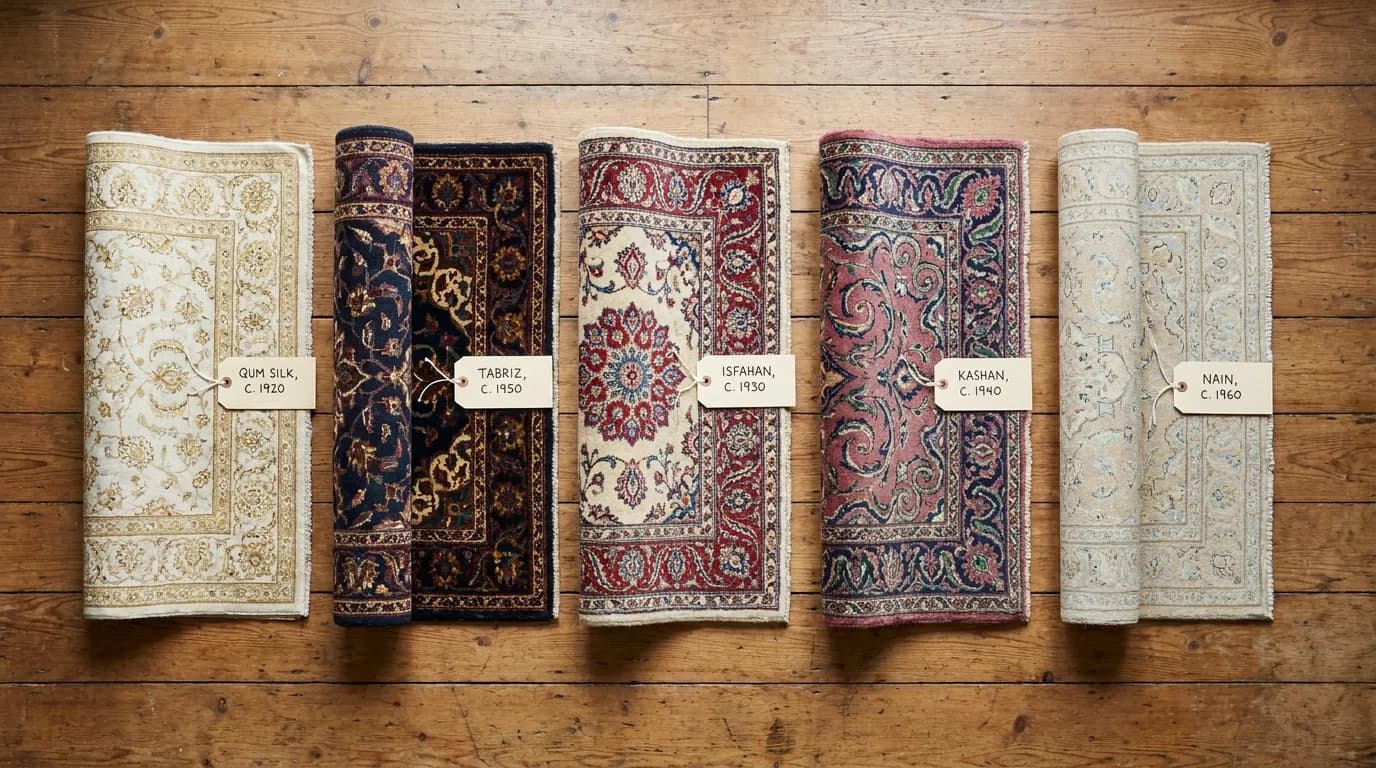
Regions covered: Qum, Tabriz, Isfahan, Kashan, Nain
Knot density range: 120 knots/dm² (entry Tabriz) to 1,000+ knots/dm² (fine Qum silk)
Primary materials: Silk (Qum), wool and silk (Tabriz, Isfahan), wool-on-cotton (Kashan, Nain)
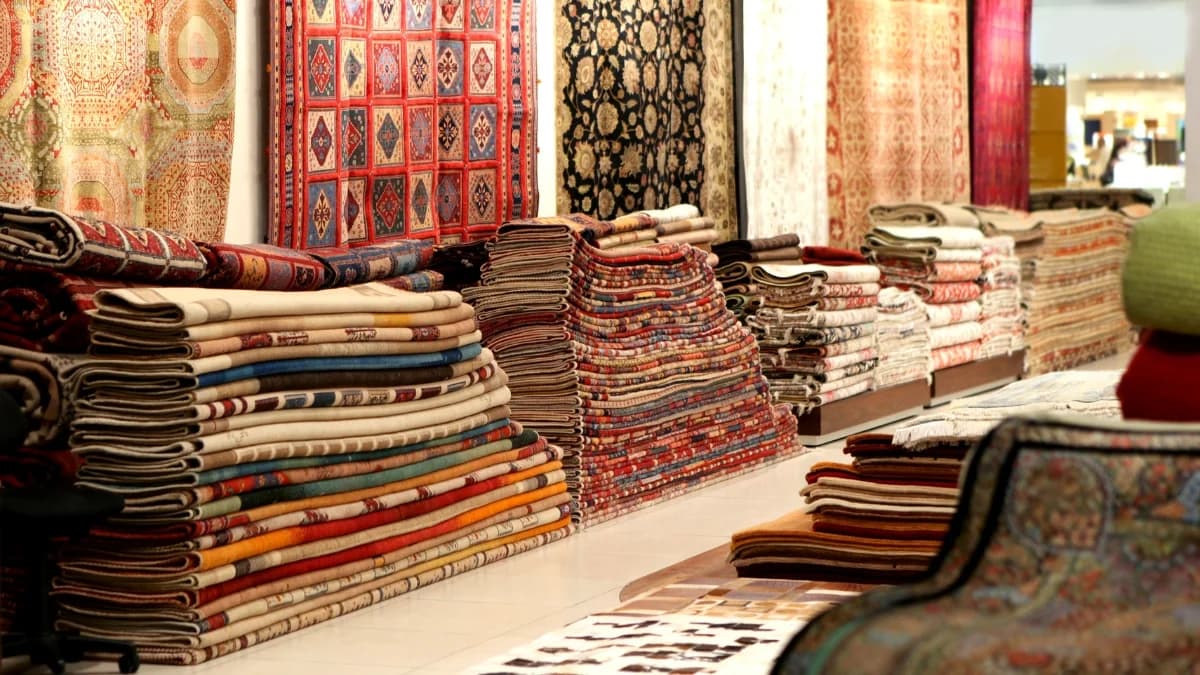
Carpets in showroom: 500+ hand-knotted Persian and Afghan pieces at Al Malakia, Sharjah
Showroom address: Shop 45–48, Central Souq Block 3 (Blue Souk), King Faisal Road, Sharjah, UAE
Free transfer available: Door-to-door from Dubai hotels; private transfer from Abu Dhabi on request
Iran has produced hand-knotted carpets for at least 2,500 years, a tradition recognised by UNESCO as an Intangible Cultural Heritage. Within that tradition, geography matters enormously: a carpet from Qum and a carpet from Tabriz can look entirely different, carry different price points, and require different care — even if both were knotted within the same decade. Understanding Persian carpet regions is the single most useful skill a buyer can develop. It lets you compare pieces honestly, ask the right questions, and avoid paying a Qum silk price for a machine-assisted imitation. This guide covers the five regions most consistently represented in quality showrooms across the UAE.
Why Region Matters More Than You Might Expect
Persian carpet weaving is not a uniform national craft — it is a collection of distinct regional schools, each shaped by local wool quality, water chemistry, dyeing traditions, and centuries of design inheritance. The city of Kashan, for example, developed a curvilinear medallion style in the 16th century that weavers there still follow today. Tabriz, as a historic trading hub near the Turkish border, developed a more eclectic vocabulary that absorbs influences from multiple directions. These are not marketing categories; they are genuine technical and aesthetic lineages that affect durability, resale value, and how a carpet ages. If you want a deeper grounding before diving into the regions, The Complete Guide to Buying Persian Carpets in the UAE covers authentication, pricing, and what to look for in person.
Region 1 — Qum (Qom): The Silk Capital
Qum sits roughly 150 km south of Tehran and began producing carpets seriously only in the early 20th century — making it relatively young compared to Kashan or Tabriz. What it lacks in age it compensates for in technical precision. Qum is almost exclusively associated with silk-on-silk construction: the pile is silk, the warp and weft are silk, and the knot densities regularly exceed 800 knots per dm², with exceptional pieces reaching 1,000+.
Design motifs in Qum carpets tend toward the ornate: hunting scenes, garden (paradise) patterns, pictorial panels, and fine floral latticework. The silk pile gives colours a luminous quality that shifts with the viewing angle — a characteristic that experienced buyers use as a quick identification test. Qum carpets are among the most expensive Persian pieces per square metre and are frequently collected rather than walked upon.
How to identify: Silk sheen with directional colour change; extremely fine knot count; often signed by the weaver in a cartouche near the border.
Region 2 — Tabriz: The Merchant City
Tabriz, in north-western Iran, was for centuries one of the great carpet-trading crossroads of the Silk Road. Its weavers use the Turkish (Ghiordes) knot, which is symmetrical and generally produces a denser, more durable pile than the asymmetrical Persian knot used in most other Iranian cities. Tabriz carpets come in wool, silk, and wool-on-silk combinations, and quality is graded by the local "raj" system: a 50-raj carpet has approximately 500 knots per dm², while a 60-raj or 70-raj piece approaches Qum-level fineness.
Design vocabulary in Tabriz is wide. You will find medallion-and-corner layouts, all-over Herati patterns, pictorial scenes, and garden designs. Colours range from ivory-and-blue formal pieces to rich reds and golds. Because Tabriz has long catered to export markets, many pieces were made to Western room proportions and are easier to fit into contemporary interiors than some other regional formats.
How to identify: Symmetrical (Turkish) knot visible on the back; "raj" grade often noted by dealers; diverse design range; durable, slightly stiff handle in wool pieces.
Region 3 — Isfahan: The Royal Workshop Tradition
Isfahan served as the Safavid imperial capital in the 16th and 17th centuries, and the carpet workshops established under Shah Abbas I set a standard that still defines the city's output today. Isfahan carpets use the asymmetrical Persian knot on a cotton foundation, with a wool or silk pile. Knot counts typically range from 400 to 700 per dm² in quality pieces. The cotton foundation — firmer than a wool warp — keeps Isfahan carpets flat and dimensionally stable over decades.
The design language is classical: elaborate floral arabesques, medallion compositions with detailed corner spandrels, and a palette dominated by deep reds, blues, and ivory. Isfahan weavers are known for the precision of their line work; even at moderate magnification the floral stems and leaf outlines appear clean and intentional. Pieces are frequently signed and many carry the name of a master workshop (ustad).
How to identify: Cotton foundation (check the warp threads at the fringe — they will be white and fine); classical floral arabesque design; clean, precise draughtsmanship in the pile.
Region 4 — Kashan: Symmetry and Depth of Colour
Kashan, roughly 240 km south of Tehran, has a weaving tradition that some historians trace back to the Safavid period. Kashan carpets use the asymmetrical Persian knot on a cotton warp and weft, with a wool pile that is characteristically clipped short to sharpen pattern definition. Knot densities in good Kashan pieces run between 350 and 600 per dm².
The hallmark Kashan design is the medallion-and-palmette layout: a central starburst or oval medallion surrounded by spiralling floral vines (arabesque) on a deep red, navy, or ivory ground. The colour palette tends toward the saturated — rich crimson, dark indigo, and forest green — which makes Kashan carpets particularly well suited to traditional interiors. They are also among the more forgiving of the fine Persian categories in terms of foot traffic, owing to their dense wool pile.
How to identify: Short, dense wool pile; deep saturated ground colour; medallion-arabesque layout; cotton foundation similar to Isfahan but generally with a slightly heavier handle.
Region 5 — Nain: Ivory Grounds and Intricate Borders
Nain is a small desert city in central Iran that began producing fine carpets only after the Second World War, when the local textile industry declined and weavers redirected their skills. Despite this recent start, Nain has established a clear identity: ivory or cream grounds, intricately detailed floral arabesques in indigo and soft blues, and very high knot counts. Nain carpets are graded by "la" (layer): a 6-la Nain has 6 warp threads per cm and is considerably finer than a 9-la piece.
The pile in Nain is often a wool-silk blend, which produces a subtle lustre without the full luminosity of pure Qum silk. The overall effect is refined and light — Nain carpets work well in rooms where a pale, detail-rich floor covering is needed without the reflective intensity of silk.
How to identify: Ivory or pale ground; indigo and blue arabesques; "la" grade (6-la being finest); light, airy feel compared to Kashan or Isfahan.
Side-by-Side Comparison: The 5 Regions at a Glance
| Region | Primary material | Knot type | Typical knot density (per dm²) | Signature design | Typical ground colour |
|---|---|---|---|---|---|
| Qum | Silk-on-silk | Persian (asymmetric) | 600–1,000+ | Garden, hunting, pictorial | Ivory, gold, red |
| Tabriz | Wool, silk, or wool-on-silk | Turkish (symmetric) | 300–700 (raj-graded) | Medallion, Herati, pictorial | Red, blue, ivory |
| Isfahan | Wool or silk on cotton | Persian (asymmetric) | 400–700 | Floral arabesque, medallion | Red, blue, ivory |
| Kashan | Wool on cotton | Persian (asymmetric) | 350–600 | Medallion-palmette arabesque | Deep red, navy, ivory |
| Nain | Wool-silk blend on cotton | Persian (asymmetric) | 400–700 (la-graded) | Floral arabesque on pale ground | Ivory, cream, pale blue |
How to Use This Knowledge When Buying
Regional knowledge becomes practical at the point of purchase. When a dealer names a region, you can cross-check: does the knot type match? Does the foundation material align? Is the design vocabulary consistent with that city's tradition? A carpet described as "Kashan" with a wool warp and weft and a symmetrical knot should prompt questions. None of these checks require laboratory equipment — they require handling the carpet, looking at its back, and knowing what to expect.
At our Persian carpet collection in Sharjah's Blue Souk, every piece is labelled with its region of origin, weaver details where available, and material composition. Our team, drawing on direct relationships with weavers in Qum, Tabriz, Isfahan, Kashan, and Nain, can walk you through any piece in detail. If you are buying for investment purposes, regional provenance is one of the primary factors affecting long-term value — alongside knot density, dye quality, and condition. For a full framework covering all of these factors together, read our complete buyer's guide for the UAE market.
Visiting from Dubai or Abu Dhabi
Al Malakia is located at Shop 45–48, Central Souq Block 3 (the Blue Souk), King Faisal Road, Sharjah. The drive from central Dubai takes approximately 30–40 minutes depending on traffic. For visitors staying in Dubai hotels, we arrange free door-to-door transfers — contact us on WhatsApp at +971 50 537 2997 to arrange a time. Guests travelling from Abu Dhabi can request a private transfer arrangement. The showroom holds more than 500 hand-knotted Persian and Afghan carpets across all five regions discussed in this guide, open Saturday to Thursday 10:00–22:00 and Friday 14:00–22:00.
Why Visit Al Malakia Persian Carpets
Al Malakia has operated from the Blue Souk in Sharjah since 2008, sourcing directly from weavers in Qum, Tabriz, Isfahan, Kashan, and Nain. As a family-owned business now in its second generation, we carry more than 500 hand-knotted pieces in the showroom at any time — not a curated selection of a dozen, but a working stock that allows genuine comparison across regions, grades, and sizes.
- Direct sourcing from Iranian weavers — no intermediary markups
- Every carpet labelled with region, material, and knot count where certified
- Free door-to-door transfer from Dubai hotels
- Private transfer arrangements available from Abu Dhabi
- No-pressure viewing — take the time you need
Address: Shop 45–48, Central Souq Block 3 (Blue Souk), King Faisal Road, Sharjah, UAE
WhatsApp: +971 50 537 2997 | Phone: +971 6 573 1399
Hours: Sat–Thu 10:00–22:00 | Fri 14:00–22:00
Get in touch or visit us in person — we are happy to explain any piece in the showroom.
Frequently Asked Questions
What is the most valuable Persian carpet region?
Qum silk carpets consistently achieve the highest prices per square metre, driven by their extreme knot density (sometimes exceeding 1,000 knots per dm²), the cost of raw silk, and the labour intensity of the weaving process. Fine Tabriz and Isfahan pieces with high raj or knot counts also command significant prices, particularly signed workshop carpets. Value, however, depends on condition, age, provenance, and documentation — region alone does not guarantee price.
Can I tell a carpet's region just by looking at the front?
Experienced buyers can make an educated guess from the front based on design vocabulary, colour palette, and pile texture. However, confirming a regional attribution requires examining the back: the knot type (symmetric vs asymmetric), the foundation material (cotton vs wool warp), and the knot density per row all provide information that the front surface conceals. When in doubt, ask to see the back and the fringe ends.
Are Afghan carpets made the same way as Persian carpets?
Afghan carpets share the hand-knotted technique and use the same Persian (asymmetric) knot in most cases, but they belong to a distinct weaving tradition. Afghan pieces — including Ersari, Chobi, and Ziegler-influenced styles — typically feature geometric rather than curvilinear designs, use hand-spun and vegetable-dyed wool, and carry a different visual vocabulary. At Al Malakia we stock both Persian and Afghan carpets and can explain the distinctions between any two pieces side by side.
How do I know if a carpet described as "Persian" is genuinely hand-knotted?
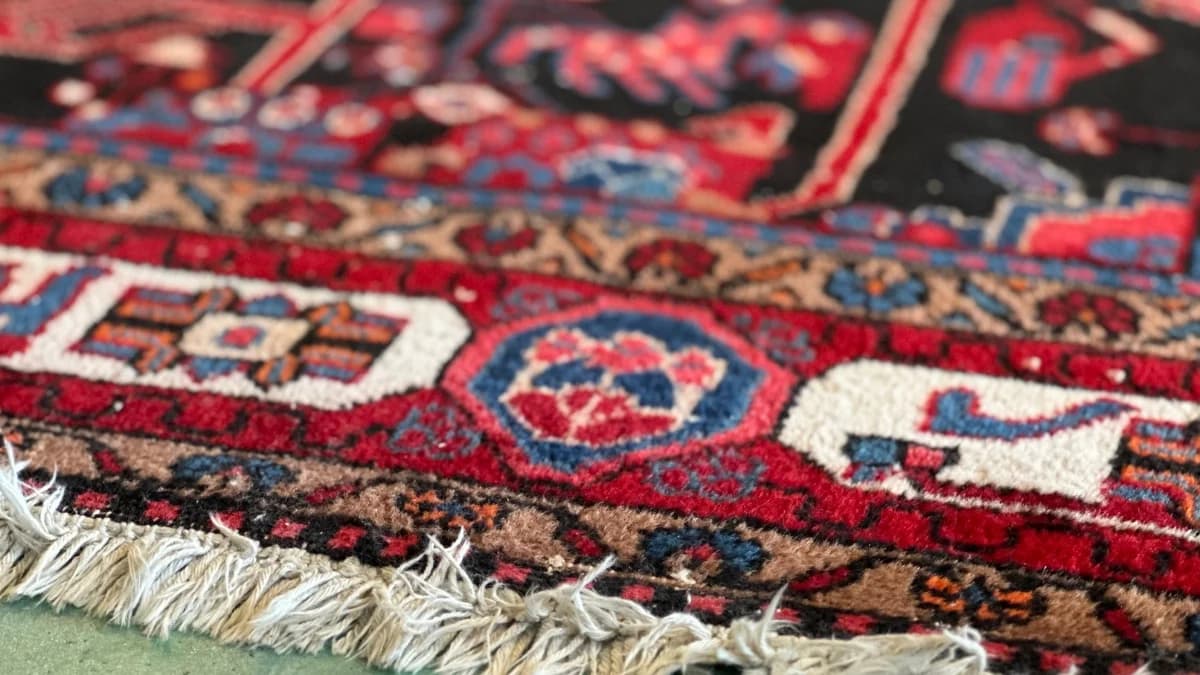
Turn the carpet over. A genuine hand-knotted carpet will show individual knots on the back — the pattern visible on the front will be reproduced in the knot structure on the reverse, though slightly blurred. Machine-made carpets have a uniform, fabric-like back with no visible knots, or a latex backing applied to hide the construction. Hand-tufted carpets, which are sometimes mislabelled, have a cut pile punched through a backing canvas and will show a cloth or latex layer on the reverse rather than individual knots.
Which Persian carpet region is best for high-traffic areas?
Kashan and Tabriz wool carpets are the most practical choices for areas with regular foot traffic. Both use durable wool pile with relatively dense knot counts, and their dark ground colours mask wear more effectively than the ivory grounds of Nain or the silk pile of Qum. Qum silk carpets are best reserved for low-traffic display settings. Isfahan is intermediate — durable enough for moderate use, but the precision of its pile rewards careful placement.
Do you ship Persian carpets internationally from your Sharjah showroom?
Yes. We arrange international shipping from our showroom at the Blue Souk, Sharjah. For details on freight options, insurance, and customs documentation, contact us directly on WhatsApp at +971 50 537 2997 or visit our contact page. We can advise on the most appropriate shipping method based on the carpet's value and destination.
Understanding Persian carpet regions is not academic knowledge — it is the practical foundation of confident buying. Whether you are looking for a fine Qum silk piece for a formal reception room, a durable Kashan for a family living space, or an Isfahan medallion carpet for a traditional interior, the regional framework gives you a language to evaluate what you are looking at. Visit Al Malakia at the Blue Souk in Sharjah, where our team can show you pieces from each of these regions in person, or message us on WhatsApp at +971 50 537 2997 to arrange a visit or a free transfer from your Dubai hotel.