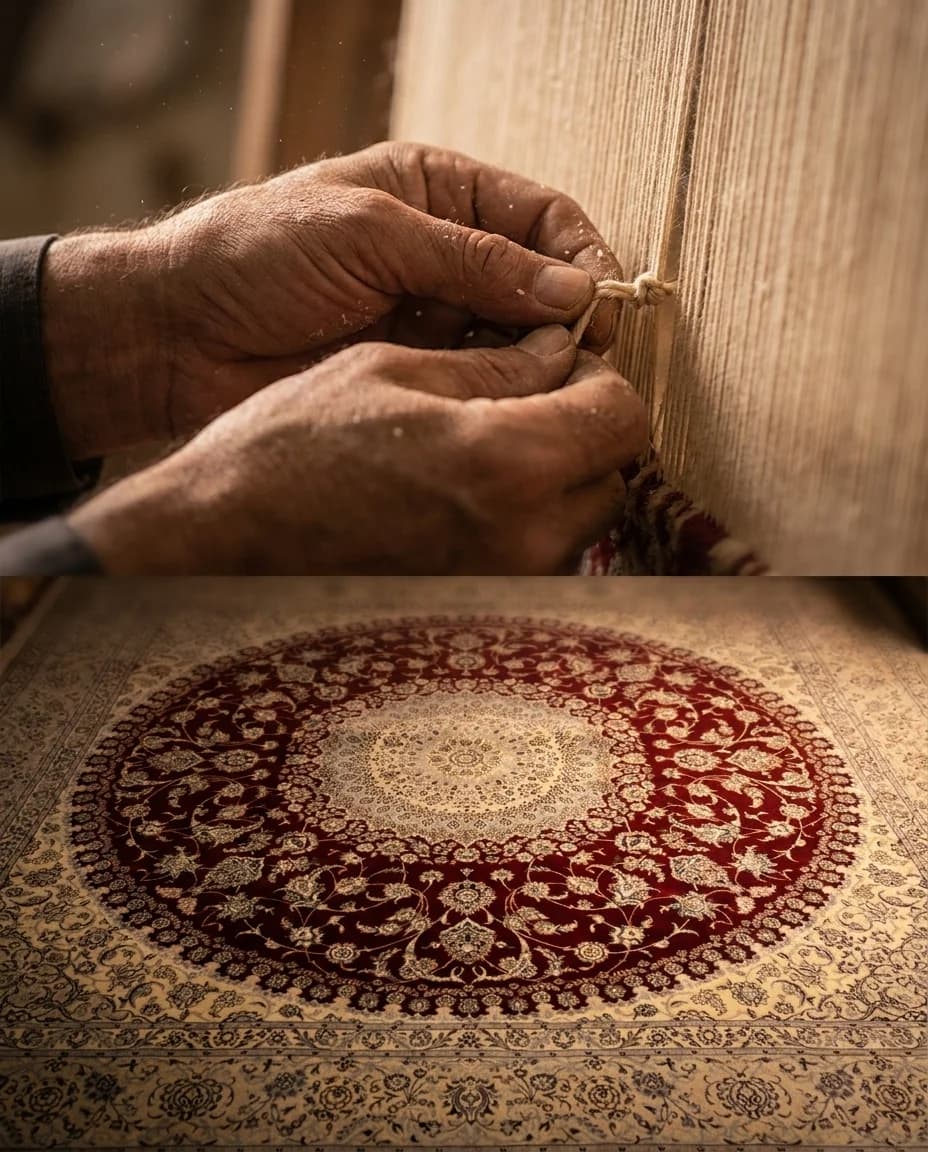
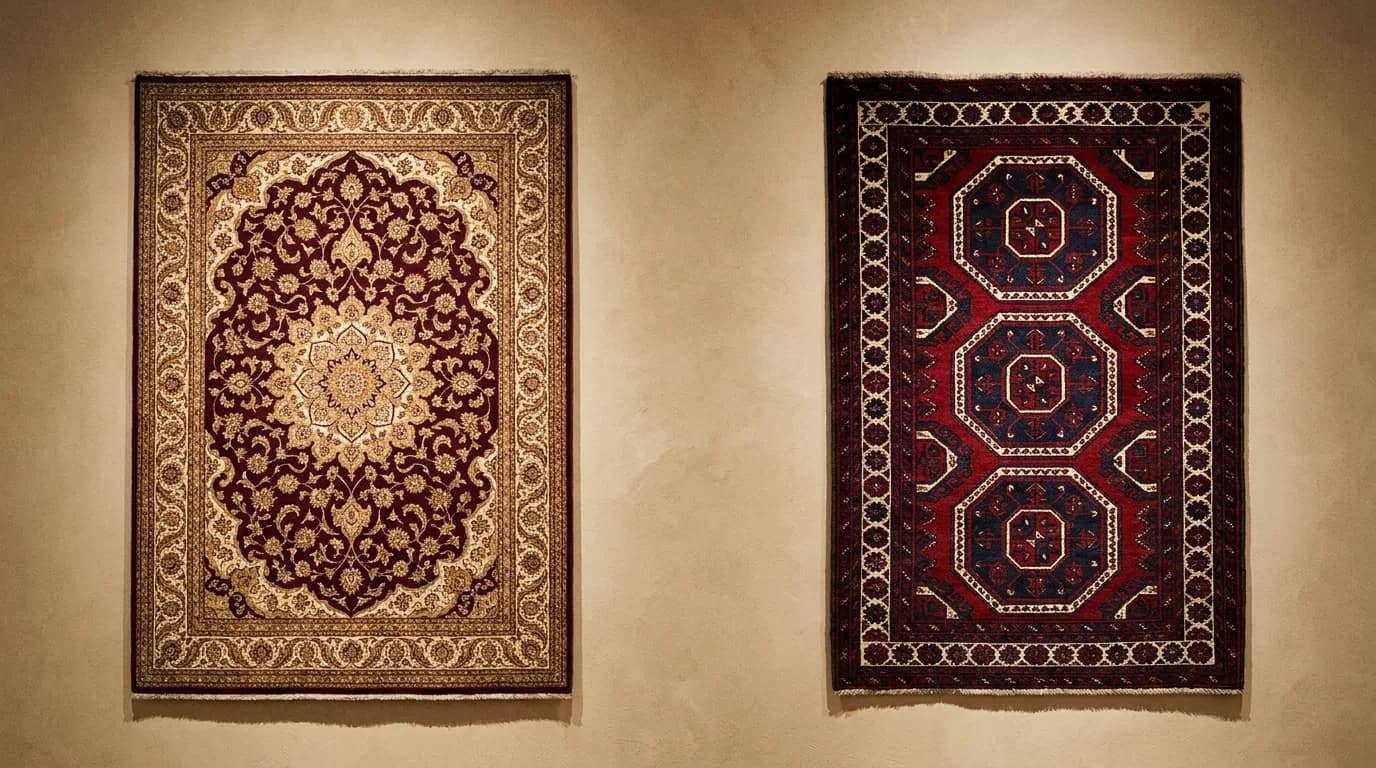
Knot density (Persian): Typically 100–800 knots per square inch (KPSI), with Qum silk reaching 400–800 KPSI
Knot density (Afghan): Typically 40–120 KPSI; valued for durability over fine detail
Primary weave structures: Persian (Senneh/asymmetric) knot dominant in Iran; Afghan pieces use both Persian and Ghiordes (symmetric) knots
Price range at Al Malakia: Entry-level Afghan wool from AED 800; Qum silk Persians from AED 8,000+
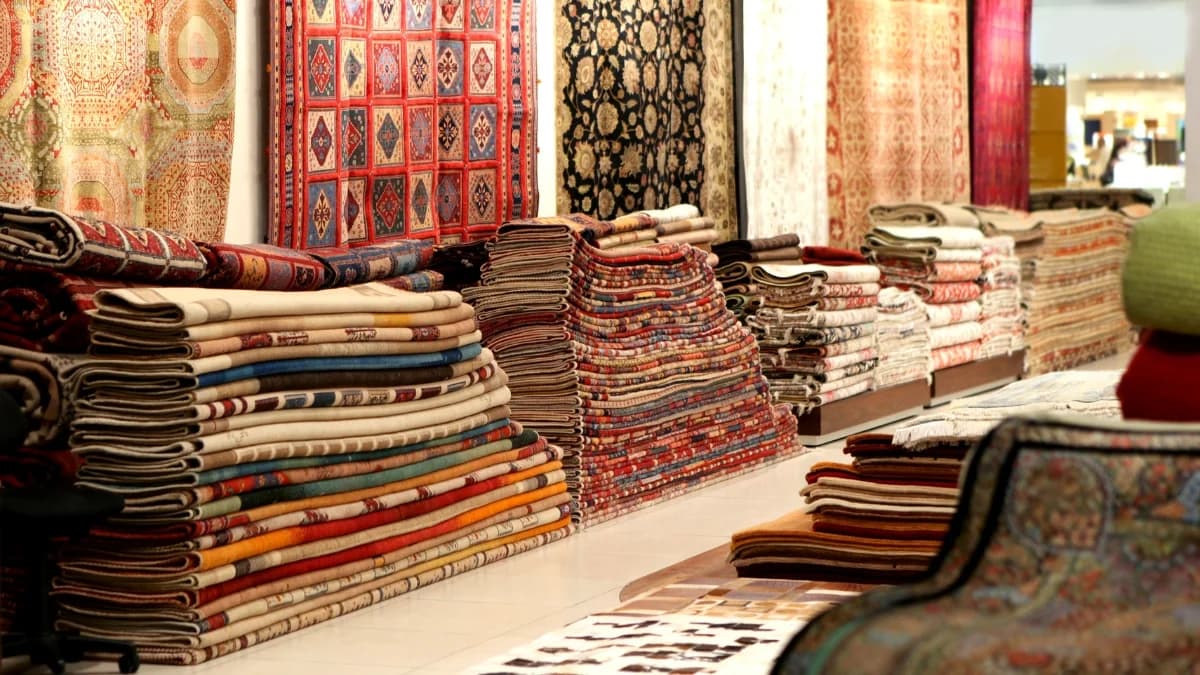
Showroom stock: 500+ hand-knotted Persian and Afghan carpets, Shop 45–48, Blue Souk, Sharjah
Direct sourcing: Al Malakia has sourced carpets directly from weavers in Iran since 2008
A hand-knotted carpet carries between 40 and 800 individual knots per square inch — and that single number tells you more about a rug's origin, value, and longevity than almost any other measure. When customers visit Al Malakia Persian Carpets at the Blue Souk in Sharjah, one of the first questions is almost always the same: "What is the difference between a Persian and an Afghan carpet?" The answer involves geography, wool quality, dye chemistry, weaving structure, and centuries of distinct cultural tradition. This guide sets out the facts clearly so you can make a confident, informed decision.
Origins and Weaving Geography
Persian carpets originate from Iran, a country with a documented carpet-weaving history stretching back at least to the 5th century BC. Each weaving city has developed its own vocabulary of design: Tabriz in north-west Iran produces bold medallion compositions in wool and silk; Isfahan and Kashan are known for intricate floral arabesques; Nain specialises in pale, finely knotted pieces with silk highlights; and Qum (Qom) produces some of the world's most tightly knotted all-silk carpets.
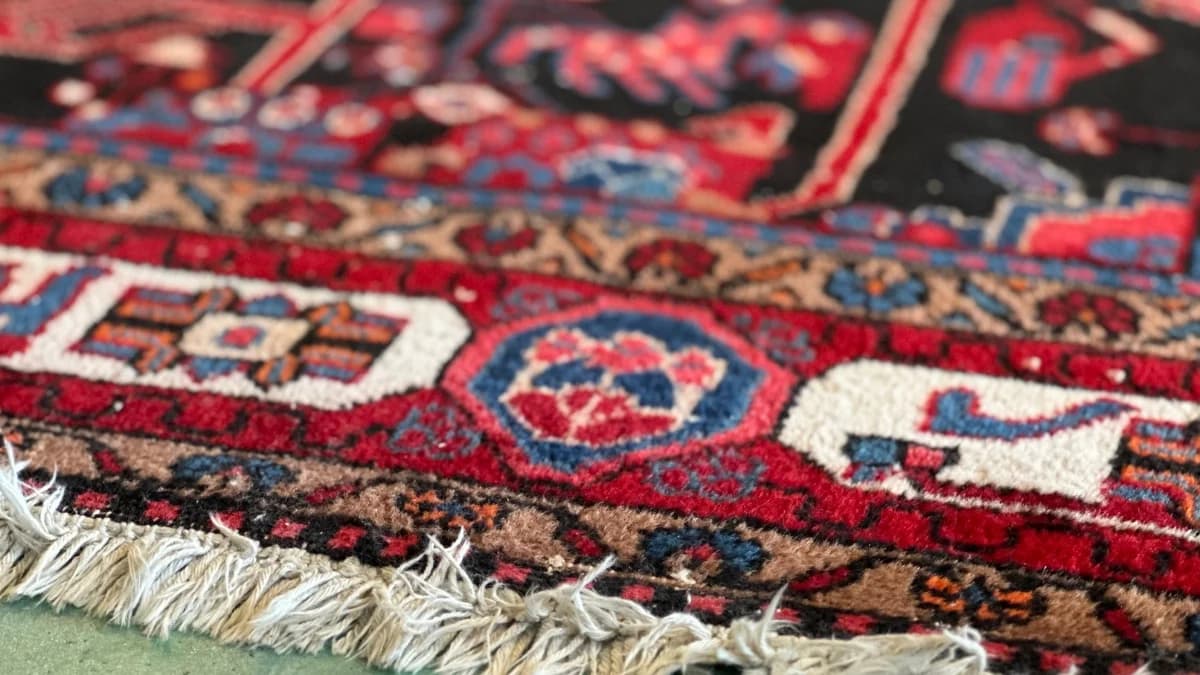
Afghan carpets come primarily from Afghanistan and from Afghan weaving communities now based in Pakistan and Iran. The dominant tradition is the geometric Turkoman style, produced by tribes including the Ersari, Tekke, and Yomut. The palette is characteristically deep — burgundy, rust-red, navy, and ivory — and the designs centre on repeating gül (medallion) motifs rather than the curvilinear floral work typical of Persian city carpets.
Knot Types and Structure
The two main knot types used in hand-knotted carpets are the asymmetric (Persian/Senneh) knot and the symmetric (Turkish/Ghiordes) knot. Most Iranian city carpets use the asymmetric knot, which allows pile to lean in one direction and enables finer detail at high knot counts. Afghan Turkoman weavers historically used the symmetric knot, though many Afghan pieces produced today — particularly those made by Afghan weavers in Pakistan — incorporate the asymmetric knot to achieve greater detail.
The foundation (warp and weft threads) also differs. Persian carpets from cities like Tabriz and Kashan often use cotton warps, which stay dimensionally stable. Traditional Afghan and Turkoman pieces use wool warps throughout, giving the finished carpet a characteristically supple, slightly heavier handle.
Wool, Silk, and Raw Materials
Wool quality is one of the clearest differentiators. Persian carpet-producing regions — particularly Khorasan in north-east Iran and the villages surrounding Isfahan — have access to high-altitude flocks whose wool has a natural lanolin content and lustre that improves with age. This wool is often hand-spun, which produces an irregular, characterful pile that catches light differently from machine-spun alternatives.
Afghan Turkoman weavers, particularly those producing in the traditional areas of northern Afghanistan, also use high-quality hand-spun wool, and many experienced buyers consider Afghan pile wool among the most durable available. However, the market for Afghan carpets is broader: lower-price Afghan pieces — particularly those exported in large volumes — may use machine-spun or even chemically treated wool, which affects longevity.
Silk is predominantly a Persian specialty. Qum silk carpets — which Al Malakia sources directly from weavers in Iran — use silk for both foundation and pile, producing a carpet that is lightweight, lustrous, and extraordinarily detailed. Afghan weavers rarely produce all-silk pieces, though silk highlights appear in some contemporary Afghan work.
Dyes: Natural vs Synthetic
Traditional Persian carpets used entirely natural dyes: pomegranate rind and madder root for reds, indigo for blue, oak gall for black, and various plant sources for greens and yellows. UNESCO recognises the traditional skills of carpet weaving in Iran as an Intangible Cultural Heritage, in part because of these complex dyeing traditions.
Many Afghan carpets — particularly those in the Turkoman tradition — were also originally natural-dyed, producing the characteristic deep vegetable-red that collectors prize. Today, both Persian and Afghan carpets are produced across the full spectrum: some use entirely natural dyes, others use high-quality chrome (synthetic) dyes that are colourfast and consistent, and lower-quality pieces may use cheaper synthetic dyes that fade unevenly.
At Al Malakia, our team — including second-generation merchant Eid Al Salam — examines dye quality as a core part of sourcing. A simple fold test, bending the pile sharply to expose the base of the knots, reveals whether dye has penetrated fully or sits only on the surface.
Design Language and Pattern
Design is perhaps the most immediately visible difference between the two traditions.
| Feature | Persian Carpets | Afghan Carpets |
|---|---|---|
| Dominant motif style | Curvilinear floral, medallion, garden, pictorial | Geometric, tribal, repeating gül motifs |
| Typical colour palette | Wide range: ivory, blue, red, green, gold | Deep reds, burgundy, navy, dark brown, ivory |
| Border complexity | Multiple guard borders with intricate detail | Simpler borders; emphasis on field repeat |
| Regional design identity | City-specific (Tabriz ≠ Kashan ≠ Qum) | Tribal-specific (Ersari ≠ Tekke ≠ Yomut) |
| Pictorial carpets | Common (hunting scenes, portraits, poetry) | Rare in traditional work |
Durability and Practical Performance
Both carpet types, when properly made, will outlast the buildings they are placed in. However, the practical differences matter for buyers choosing a carpet for a specific context.
Afghan Turkoman-style carpets with wool foundations and a lower knot count are exceptionally resilient. Their denser, shorter pile sheds less and holds up well under heavy foot traffic — they are frequently recommended for hallways, dining areas, and rooms with children or pets. Persian city carpets, particularly those with cotton foundations and higher knot counts, are somewhat more susceptible to moisture and require more careful placement. Qum silk pieces are typically reserved for low-traffic areas or display use.
For a broader overview of how to evaluate any hand-knotted carpet — including foundation checks, pile tests, and what to ask a dealer — see The Complete Guide to Buying Persian Carpets in the UAE.
Price Differences and What Drives Them
Price in hand-knotted carpets is driven by four primary variables: knot count, material cost, time to weave, and provenance. A 3×2 metre Qum silk carpet with 600 KPSI may represent 18 months of a single weaver's work. An Afghan Ersari carpet of similar size at 80 KPSI might take six weeks. Both are entirely handmade and genuinely valuable — but they serve different markets and purposes.
At Al Malakia's showroom in the Blue Souk, Sharjah, entry-level Afghan wool pieces start from around AED 800 for smaller formats, while mid-range Persian wool carpets (Tabriz, Kashan) in a 3×2 metre size typically range from AED 6,000 to AED 25,000 depending on age, knot count, and condition. Qum silk pieces begin from AED 8,000 for small formats and rise substantially for room-size carpets.
Which Should You Choose?
The honest answer is that neither tradition is superior — they are different, and the right choice depends entirely on your context, aesthetic preference, and budget.
- Choose a Persian carpet if you want intricate floral or medallion design, a wide colour range, or are investing in a piece that will appreciate over time.
- Choose an Afghan carpet if you prioritise durability and tribal geometric patterns, want a piece suited to high-traffic areas, or are working within a tighter budget without compromising on handmade quality.
- Consider both in conversation with a specialist — many buyers are surprised to find an Afghan piece suits a room better than the Persian they originally had in mind, or vice versa.
Our full collection of Persian and Afghan carpets spans both traditions, with over 500 pieces in the showroom at any one time.
Why Visit Al Malakia Persian Carpets?
Al Malakia has operated from Shop 45–48, Central Souq Block 3 (the Blue Souk), King Faisal Road, Sharjah, since 2008 — a family-run business that sources directly from weavers across Iran. With more than 500 hand-knotted Persian and Afghan carpets in the showroom, our stock covers every major weaving tradition, from Qum silk to Turkoman tribal wool.
We offer free door-to-door transfer from Dubai hotels for serious buyers, and can arrange private transfers from Abu Dhabi. There is no obligation to purchase. Our team speaks Arabic, English, and Farsi. Open Saturday–Thursday 10:00–22:00, Friday 14:00–22:00.
Call: +971 6 573 1399 | WhatsApp: +971 50 537 2997 | Contact us here
Visiting from Dubai? See our Dubai visitor guide. Coming from Abu Dhabi? Visit our Abu Dhabi visitor page.
Frequently Asked Questions
Is a Persian carpet always more valuable than an Afghan carpet?
Not necessarily. Value in hand-knotted carpets is determined by knot density, material quality, age, dye integrity, and condition — not origin alone. A high-quality antique Afghan Turkoman carpet with natural dyes and fine wool can command a higher price than a low-grade Persian carpet with synthetic dyes and machine-spun wool. The two traditions are not in a simple hierarchy; they are different, with different strengths.
How can I tell a Persian carpet from an Afghan carpet by looking at it?
The most reliable visual indicator is the design: Persian city carpets typically feature curvilinear floral patterns, arabesques, or detailed medallions with complex borders. Afghan Turkoman-style carpets almost always feature geometric repeating gül motifs in a deep red or burgundy field. Turning the carpet over and examining the knot structure can confirm this — Afghan Turkoman pieces often show a more pronounced, uniform geometric knot grid on the back, while fine Persian carpets show a finer, denser grid. A specialist can identify the origin within seconds from pile texture and wool character alone.
Do Afghan carpets last as long as Persian carpets?
A well-made Afghan carpet with a wool foundation, hand-spun wool pile, and natural or quality synthetic dyes is extraordinarily durable — in some respects more so than fine Persian city carpets, which prioritise detail over robustness. Afghan tribal weavers have historically produced carpets intended to withstand nomadic use. With correct care — regular rotation, professional cleaning every three to five years, and avoidance of sustained moisture — either type will last well over a century.
Are all Afghan carpets made in Afghanistan?
No. A significant proportion of carpets sold as "Afghan" are woven by Afghan weaving communities living in Pakistan, particularly around Peshawar and Karachi. These are genuine hand-knotted pieces in the Afghan tradition, often using the same tribal designs and techniques, but woven outside Afghanistan. There are also Afghan-style carpets produced in Iran by Afghan refugee communities. The key quality indicators — knot count, wool quality, dye integrity — apply regardless of the specific country of production.
Can I see both Persian and Afghan carpets in the same showroom?
Yes. Al Malakia's showroom at the Blue Souk in Sharjah carries over 500 hand-knotted pieces from both traditions simultaneously. Being able to place a Tabriz wool carpet and an Ersari Afghan carpet side by side — feeling the pile, comparing the dye depth, examining the reverse — is by far the most effective way to understand the differences in practice. We encourage visitors to handle the pieces freely. Our team can guide you through the comparison without pressure. See our about page for more on how we source directly from weavers in Iran.
What is the difference between a Turkoman carpet and an Afghan carpet?
"Turkoman" (or Turkmen) refers to the weaving tradition of the Turkic tribes historically centred across Central Asia — including parts of present-day Afghanistan, Turkmenistan, and Iran. "Afghan carpet" is a broader commercial category that often encompasses Turkoman-style pieces made by Afghan weavers. So while not all Afghan carpets are Turkoman in style, a large proportion of the Afghan carpets traded internationally follow the Turkoman design vocabulary: geometric gül repeats, deep red foundations, and wool-on-wool construction.
For a complete guide to evaluating, buying, and caring for any hand-knotted carpet in the UAE — whether Persian or Afghan — read The Complete Guide to Buying Persian Carpets in the UAE. Or come and see the collection in person: Shop 45–48, Blue Souk, Sharjah. WhatsApp us on +971 50 537 2997 to arrange your visit or to ask any questions before you travel.